Cycling often brings people together – sharing group rides, swapping stories, and comparing gear. But some of the most meaningful moments in my cycling journey have come from trying new things and discovering what truly resonates with me, even if it wasn’t what everyone else was doing.
Whether it’s riding a muddy bridleway just for fun or experimenting with different cycling disciplines, I’ve found that exploring new paths can lead to the most rewarding experiences. This post is a celebration of those moments – and an invitation to explore your own path.

Growing up in Edinburgh, I had a mountain bike and spent hours exploring on it — or so I thought. Looking back, it seems the definition of mountain biking has evolved since those days. My fully rigid bike with 26-inch wheels would probably be considered a hybrid now.
Back then, I spent most of my time trundling around the Pentland Hills on sheep herding trails— this was long before proper off-road courses existed.
Nowadays, it seems you’re not truly mountain biking unless you’re bunny-hopping off a house in full body armor on a dual-suspension bike (or “double boinger,” as they’re called). What I was doing back then might now be classified as cross-country or cyclocross.
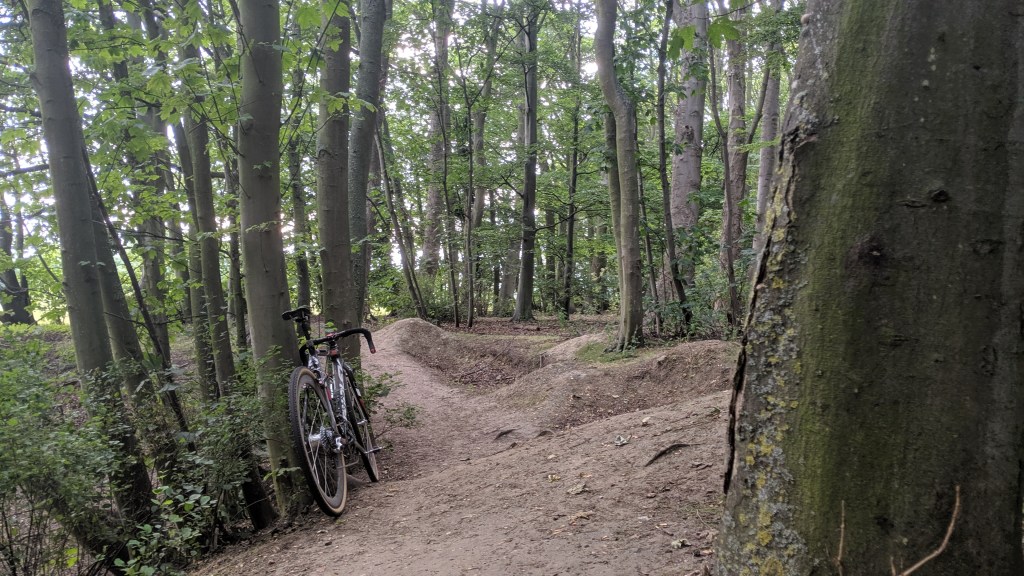
When I first moved to England, finding off-road trails felt like a challenge. I often encountered “Get orf my land” types wielding shotguns. Yes, this really happened — they didn’t point the shotgun at me, but they did wave it around while yelling at me to go away.
In my cycle club I was known as a “road man” and when my roadie friends found out that I liked off roading they would relentlessly mock me for my “filthy habit”.
Eventually, I discovered Ordnance Survey maps — and they’re awesome. These maps are packed with fascinating details, particularly about bridleways, greenways, unsurfaced roads, and footpaths. I was amazed by the labyrinth of trails freely accessible around Cambridgeshire, if you know where to look. Since some paths can be easy to miss, having a map is essential.
OS maps are great but can be quite pricey. However it’s possible to get them online for free. Simply go to Bing maps (yes, it does have a purpose after all) and select the Ordnance Survey overlay. It won’t show up if you are zoomed out too far.
Understanding the symbols on these maps can be tricky, but there are guides online. Here’s a quick breakdown:
- Red dashed lines with occasional red diamonds: bridleways
- Green filled circles: greenways on tarmacked roads
- Green hollow circles: greenways on untarmacked roads
- Alternating dash and plus signs: byways
- Dashed red lines: footpaths
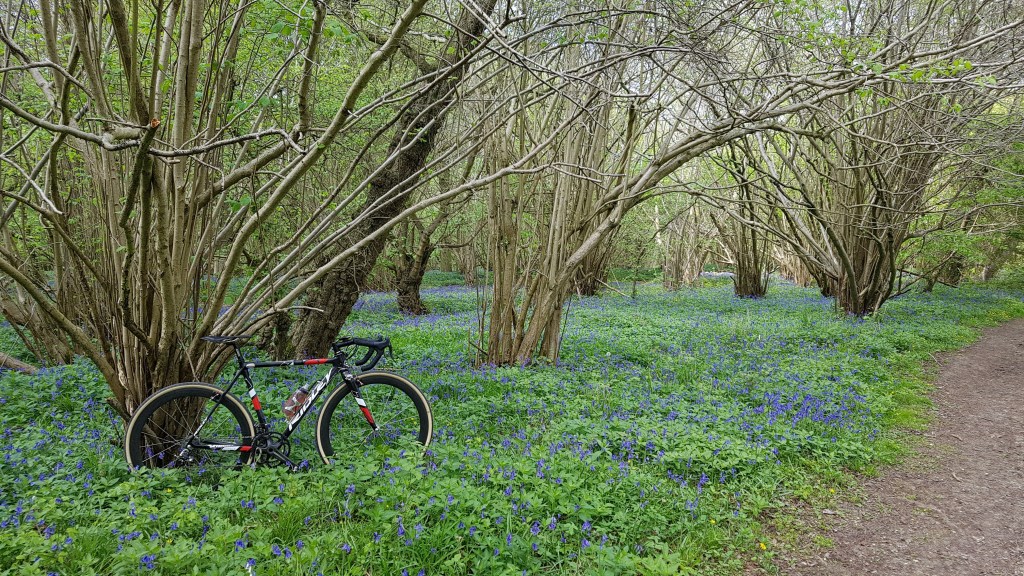
“There’s a difference between knowing the path and walking the path,” and this is especially true when traipsing around a freshly ploughed field searching for a bridleway. Since many paths are poorly marked, having a GPS track to follow is essential.
When planning a ride, I usually pick a specific area and map out a route combining bridleways, byways, and greenways. Tools like Garmin Connect or Strava are perfect for plotting routes, which I then transfer to my cycle computer before hitting the trails.

I still have my MTB, but I prefer a light bike that’s easy to flick around. It’s much more fun when you can hop, pump, jump, or manual (MTB-speak for wheelie) around obstacles.
That’s why I opted for a cyclocross bike — super cheap because it had been pre-raced, pre-crashed, and pre-repaired by a pro bike team (Sunweb). So, it wasn’t just crashed — it was “professionally crashed.”
Mountain bikers love their fancy tech, and I’ll admit — I indulge in the shiny stuff too, which is why I went full Campagnolo Record, naturally. MTB enthusiasts go all gooey over Campag.
It’s a very MTB thing to color-match all your bolts, and it’s quite a challenge to find anodized components in just the right shade of red. Bling it on!
I must admit I have a real weakness for Dugast Pipistrello tubs. Their cotton sidewalls and latex inner tubes simply glide across rocky and rutted paths at 20mph.
They are lush… and expensive… and like to go pop.
My favourite ride goes through the backlanes and bridleways to Thetford. I let out almost all the air from my tyres then thrash around the red routes before pumping the tyres back up and heading home.
There was one thing I never adopted from my MTB friends; it seemed to be an unwritten rule that if you don’t fall off at least once per ride then you are not trying hard enough.
This is probably for the best though as when I crash I tend to shatter, not bounce.
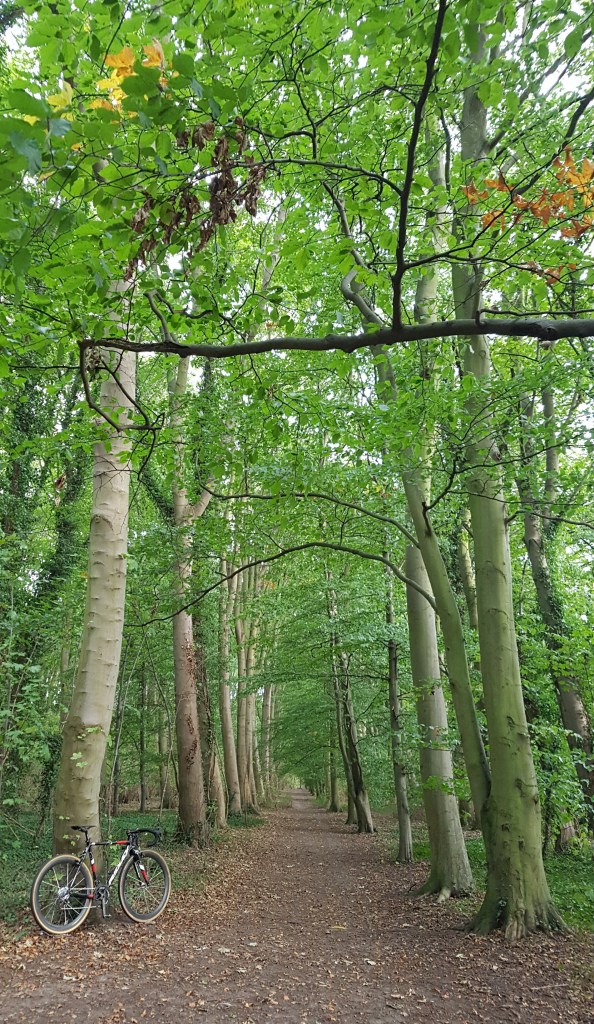
Many bridleways were once ancient paths or roads, and riding along them feels like traveling back in time.
I’m always amazed by how spectacularly beautiful and tranquil these hidden trails can be — often just minutes from busy roads, tucked away in plain sight.
When I started riding and racing with a club, I began with road racing because it was what my peers and the people I looked up to were doing.
But after a while, I started trying other disciplines — things like track, MTB, coaching, riding in the mountains, and time trialling.
Some of these really resonated with me, and I loved them.
Doing the cycling things your friends do is great, but there’s a whole world of possibilities out there to explore.
So, in the nicest possible way, why don’t you go out on your bike and “get lost”? You don’t know what you might find — it could be something that truly resonates with you.
Life is about choosing your own direction, even if it’s not the most traveled one.
Robert Frost – The Road Not Taken:
Two roads diverged in a yellow wood,
And sorry I could not travel both
And be one traveller, long I stood
And looked down one as far as I could
To where it bent in the undergrowth;
Then took the other, as just as fair,
And having perhaps the better claim,
Because it was grassy and wanted wear;
Though as for that the passing there
Had worn them really about the same,
And both that morning equally lay
In leaves no step had trodden black.
Oh, I kept the first for another day!
Yet knowing how way leads on to way,
I doubted if I should ever come back.
I shall be telling this with a sigh
Somewhere ages and ages hence:
Two roads diverged in a wood, and I –
I took the one less travelled by,
And that has made all the difference.
 Davide la Locomotive
Leave a comment