This is the story of how I accidentally became the local distributor of seasonal enchantments and light-powered neighbour astonishment.
It all started with a forgotten box of Christmas cards…
My neighbour had given me one, but I didn’t have any to return. I’d meant to pick some up at Tesco’s, but forgot. And the idea of going back out just to buy bits of overpriced cardboard? Not happening.
I’d just got my 3D printer at the time, and like most new converts, I was trying to solve everything with it. So I wondered: what would a 3D-printed Christmas card even look like?
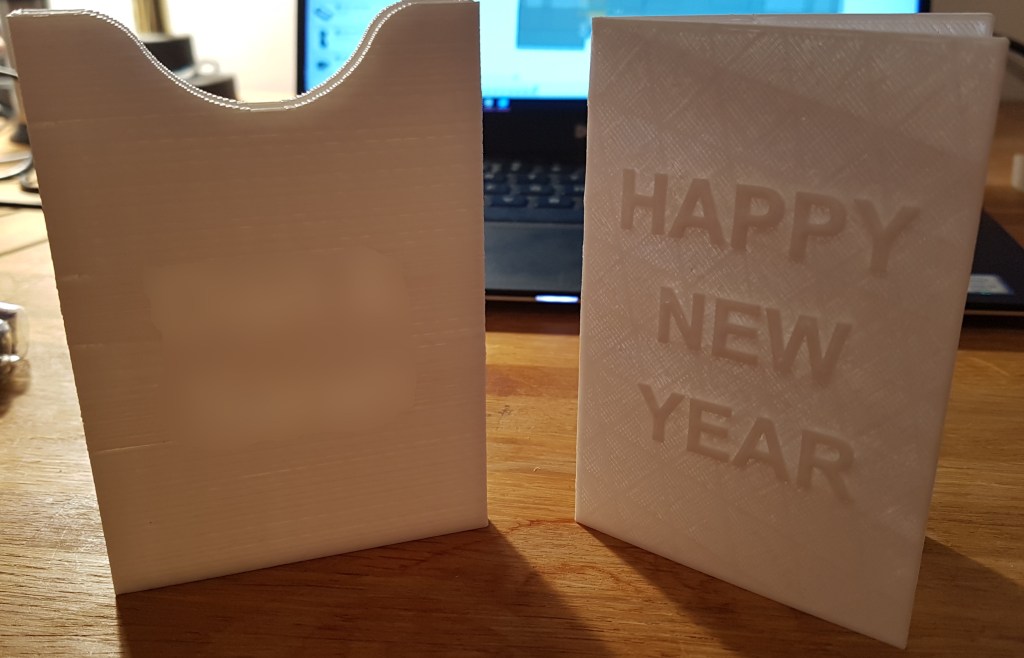
In the past, I’d had lots of prints come unstuck after the first few layers. But that led to a discovery—if I printed something with just a couple of layers, I could fold it into a simple hinge. Suddenly, I had the bones of a card. A weird one, sure, but it worked.
I added a simple stencil font message. It took me so long to create that I missed Christmas entirely. I’d wanted to explain that… but my computer would crash every time I tried to render all the characters. So I went minimal.
I printed a sleeve as an envelope, dropped it through their letterbox, and forgot about it.
It didn’t look great or fancy—but as they say, “it’s the thought that counts.”
Months later, they dropped off a package for me and mentioned the card.
“That was 3D printed, wasn’t it? It was really cool.”
I was surprised they remembered. I’d forgotten—it was many prints ago. I was a little proud, if I’m honest.
The next year, they gave me another card. I printed a new one with an embossed Christmas tree, learning how to convert images into SVGs along the way. This became a thing. We didn’t really see each other much—but once a year, we exchanged cards. And each year, I tried to make mine a little more intricate. A little weirder.

The next year, I was bored of just 3D printing flat cards—I wanted to make a 3D-3D printed card, 3D2 if you like. One that actually stood up and popped out. It took ages to figure out all the little pivots and joints (and yes, it broke. A lot). But I got there in the end.
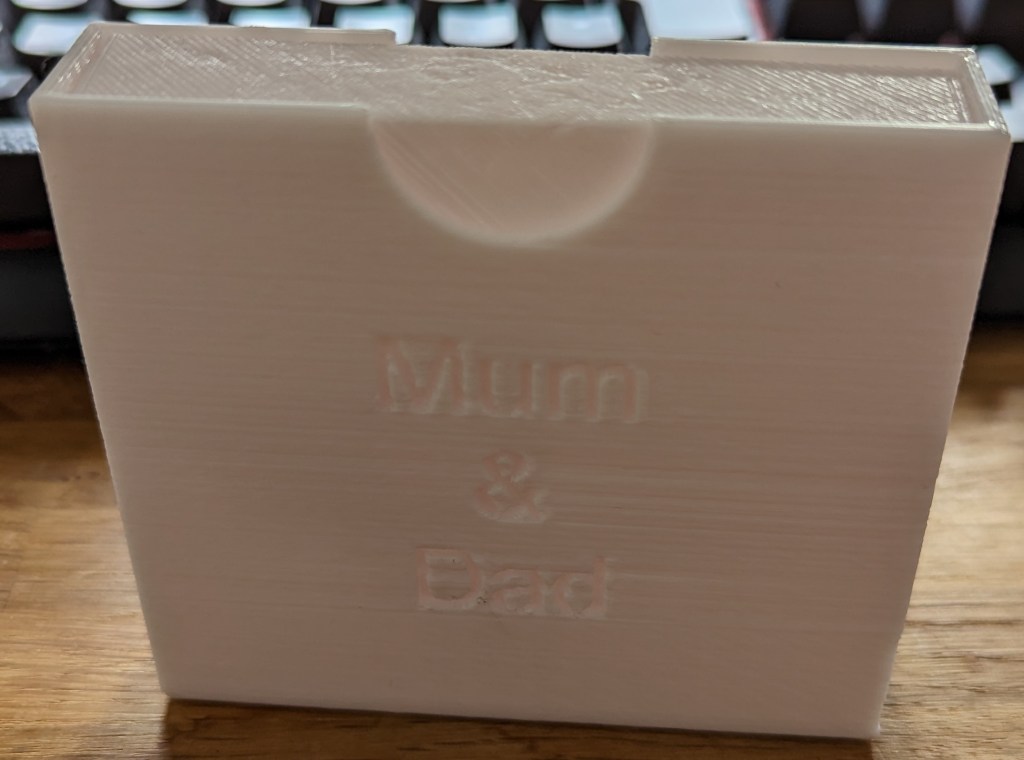
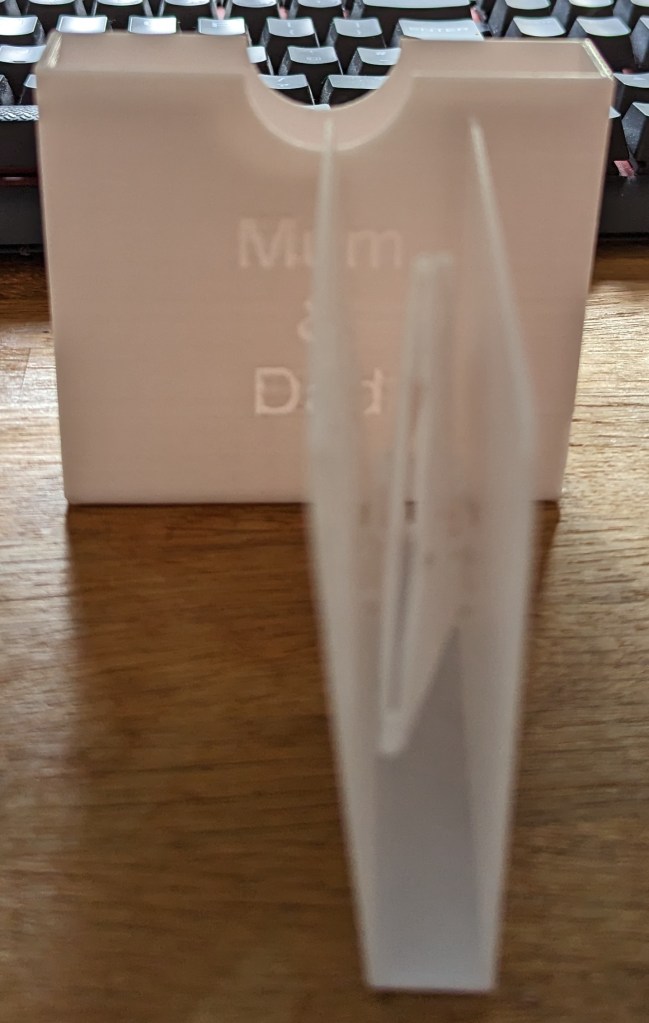
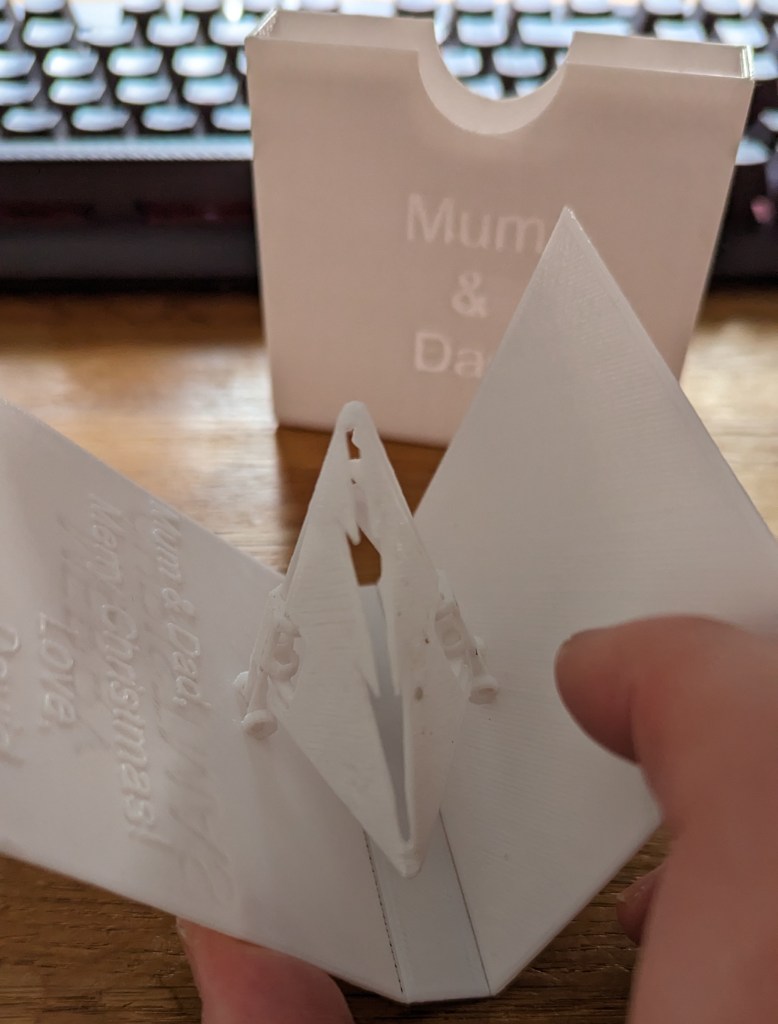

The first of the pop-up card experiments. Structurally questionable. Emotionally committed.
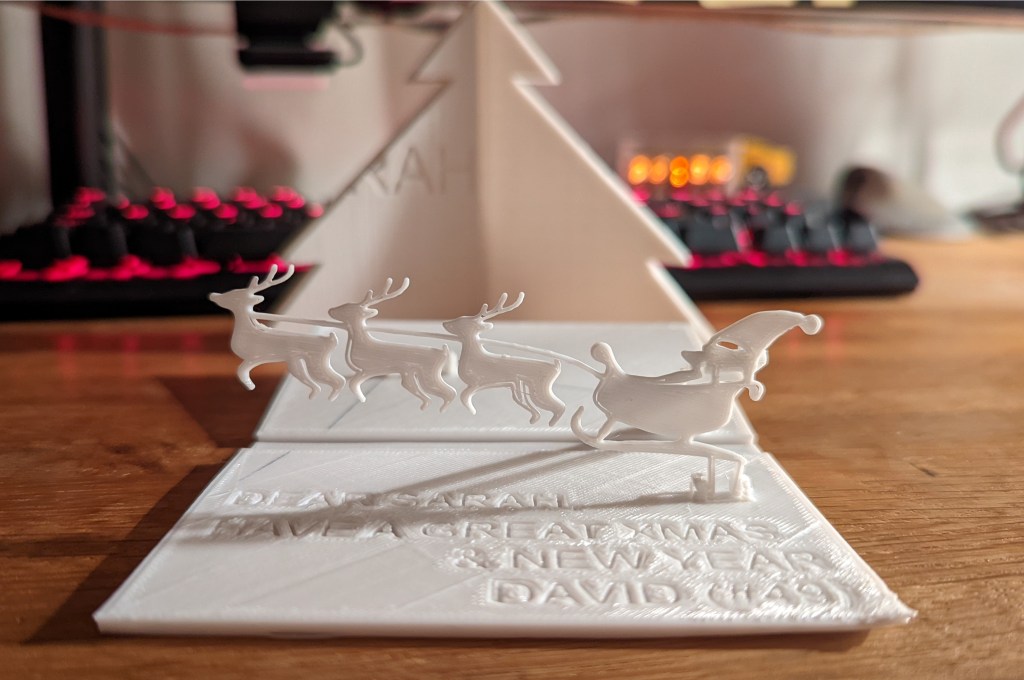
The final year before I moved out, I went all in. I designed a pop-up snowscape with tiny hinges and pivots. When you opened the card, Santa’s sleigh and reindeer popped up into the air like a miniature theatre set. The envelope split diagonally and attached to the card to become a Christmas tree backdrop. A full holiday diorama, disguised as a humble rectangle of plastic.
She was a doctor, and that was during COVID, so I never got to see the reaction.
I hope it brought a smile. Maybe even a chuckle.
I was giving the same cards to my parents. My dad spent ages trying to figure out how the envelope could become a tree—even whilst holding it in his hands. I watched him slowly turn it, eyes squinting, gears turning. He looked like someone trying to explain a magic trick to himself.
Then I moved.
On day one in the new house, I was taking pictures of the outside when someone suddenly appeared. I jumped.
It was Stuart, my new neighbour.
“Are you moving in?” he asked.
I said yes.
He said he was glad—it had been empty too long. I told him it was a lovely house. He offered to help if I needed anything and walked off.
A few minutes later, I was photographing the electricity meter and he popped up again, startling me a second time. This time he asked if I wanted to come round for afternoon tea with Rose, his wife. I had loads to do, but said yes anyway.
They made me feel welcome in that quietly generous way some people do without even trying. That stayed with me.
So for Christmas that year, I printed one of my pop-up cards for them. When I handed it to Stuart, he said,
“Thanks very much,” paused, and stared at the plastic rectangle in his hand.
“But… what is it?”
Fair question.
I’d forgotten that I might be the only person handing out cards made from rigid filament. So I showed him: how it unfolded, how the “envelope” clipped on as a tree stand. He stared, blinking. Then said, “Wow.”

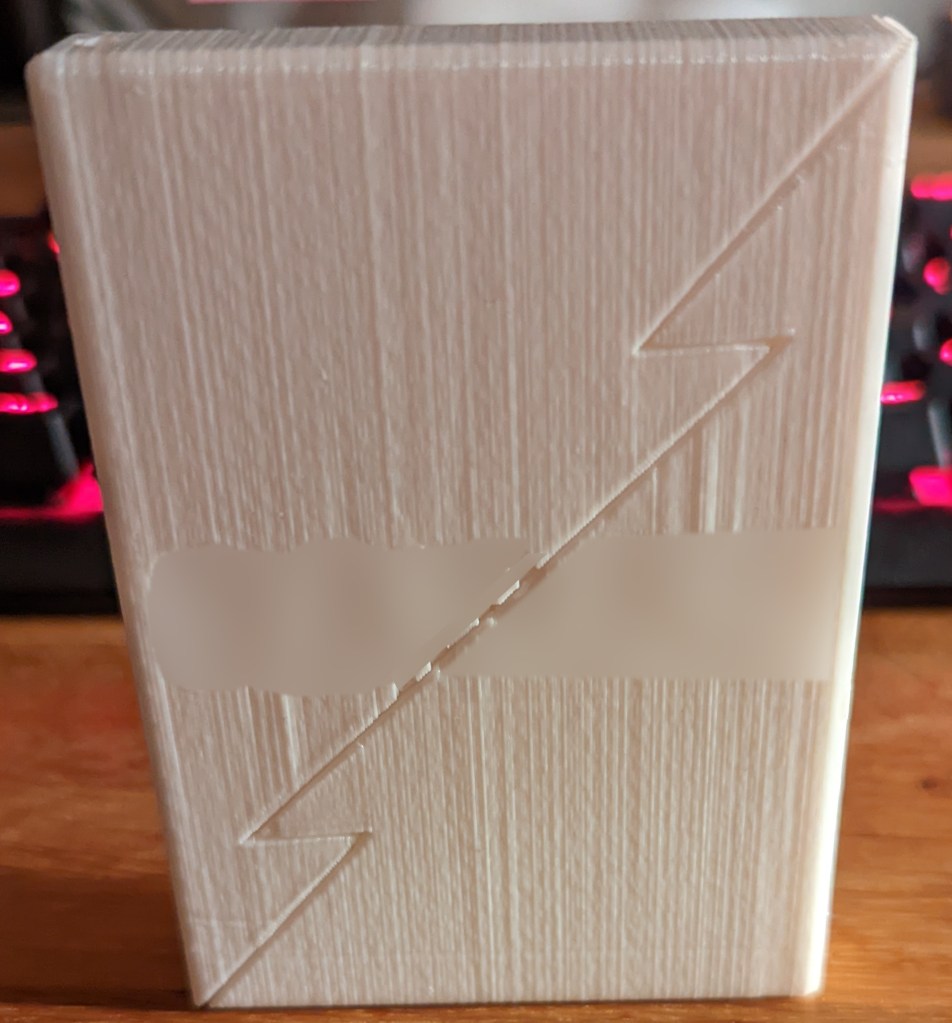
Brain gently exploding—in the nicest way.
Later that summer, he popped round again for a casual chat. As he was leaving, he turned and said,
“We’ve still got your card!”
I said, “I’ve still got yours too.”
Then he added something that stunned me:
“When people come round to visit us, we bring out the card and show them.”
I hadn’t expected that. But it was… cool. Like a weird little heirloom. They really loved it.
My brain softly exploded.
By now, I was getting competitive with myself. Each year had to be more intricate, more out-there. For the latest one, I designed a card that folds into a 3D Christmas tree—with integrated LED lights. The envelope becomes the base.
I spent days of late nights trying to get it to work. Hinges kept breaking. At 1am on Christmas Eve, I gave up. Thirty seconds later, a new idea arrived. I’m not giving up that easily.
By 3am, it worked.
That evening, I popped over and gave them the card. They watched me unfold it into a tree.
“Oh, look at that,” they said, already impressed.
Then I switched on the lights.
Gasp.
“Wow.”

Explosion achieved.
A few months later, I gave them a 3D-printed light I’d designed. They just stared at it.
“There’s something hypnotic about it,” they said.
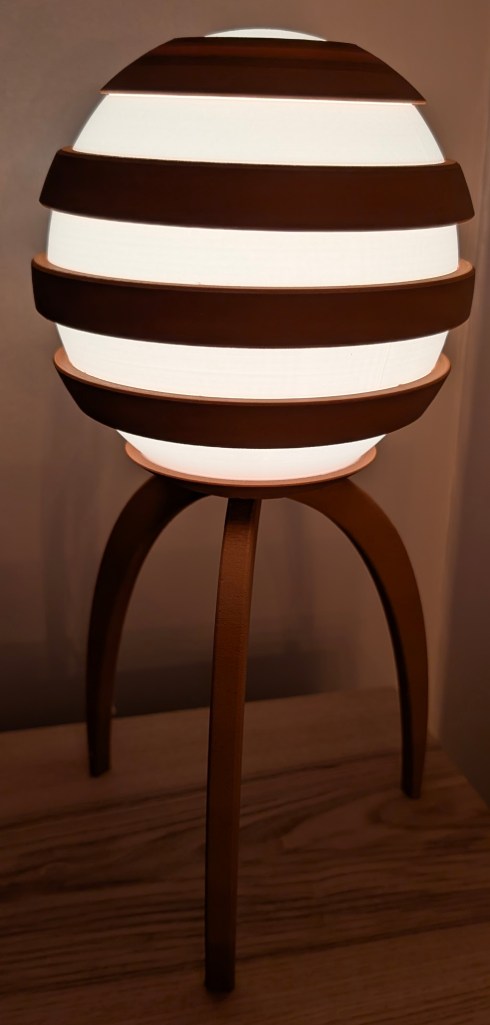

I almost explained—all the little details—but that would be like explaining a magic trick. It would lose its sparkle.
Better to let them wonder.
Cards aren’t just bits of cardboard or plastic. They’re something more, something special.
They’re a way of saying, “In my heart, you belong.”
When someone does something kind—
something just for somebody,
with no catch, no reason other than because—
it sticks.
It might be a thing,
or a gesture,
or simply a moment shared.
It settles somewhere in us.
Maybe not in words,
but in feeling.
I didn’t realise the impact that something like that could have.
And that made my brain softly explode.
Nuclear reactions begin with a single collision.
One particle strikes another, releasing heat and energy—and more particles.
A chain reaction. Self-sustaining. Spreading.
Normally, carbon rods are inserted to keep that energy in check. To slow it down.
To stop it from going critical.
In 1986, the workers at Chernobyl removed too many of those rods. The reaction became unstoppable. The reactor exploded, and radioactive particles spread across Europe. Even today, tiny traces of those particles live in all of us.
It was a tragedy—one of the most catastrophic nuclear events in history.
But here’s a thought:
What if we could trigger a different kind of chain reaction?
What if kindness worked like fission?
One thoughtful act sparks another. One surprise gift leads to someone else’s small joy.
One release of wonder unfolds and triggers another.
Usually, we insert our own carbon rods—hesitation, awkwardness, cynicism.
We dampen the impulse.
We keep it from going critical.
But what if we didn’t?
What if we removed just enough barriers to let it spread—wild, bright, unstoppable?
Lots of little, gentle brain explosions.
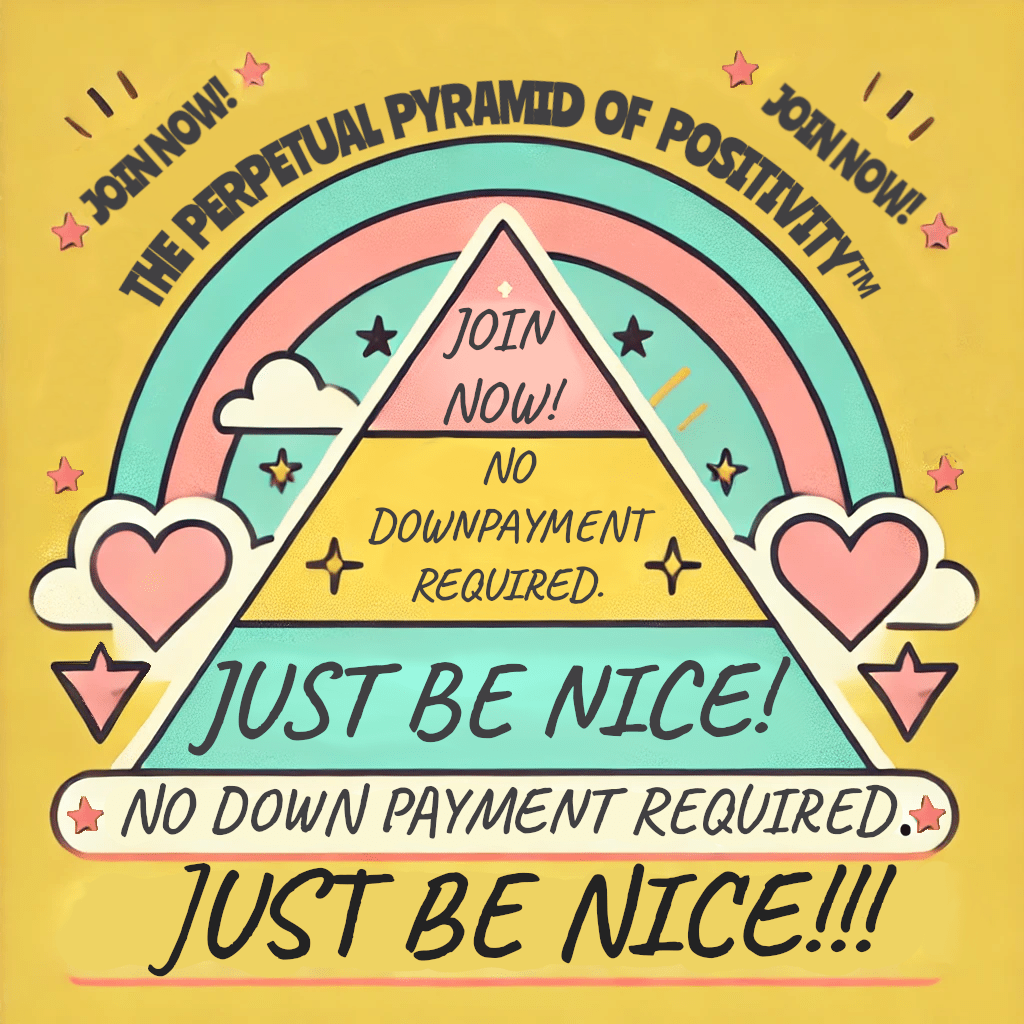
Introducing:
The Perpetual Pyramid of Positivity™
The only pyramid scheme where everyone wins — and you actually hope it collapses.
If one person did a good thing for just two people today —
and each of those two did the same —
in a 33 days, the world’s most wholesome pyramid scheme would hit critical mass.
A criticality of kindness. Of wonder.
A warm, glowing chain reaction that covers everything.
Slowly. Softly.
Until eventually, some small part of that kindness lives inside all of us.
You.
And me.
*No heads were harmed in the making of this blog post. All explosions were metaphorical, gentle, and mostly involved soft gasps and wonder.*
 Davide la Locomotive
Leave a comment