
We talk about failure like it’s the opposite of success.
Like once something breaks, you’ve lost.
But what if failure isn’t a dead end?
What if it’s part of the path?
This is a story about 3D printing, plastic disasters, and a few ideas that turned out way better than planned.
But it’s also about something bigger:
Why failure isn’t what we think it is.
And why avoiding it might be the real mistake.
I recently designed a mount for my Garmin bike computer.
The success criteria? Pretty simple:
If I go for a ride and it doesn’t fall off… that’s a win.
Guess what?
It fell off.
I hit a bump, and it went bouncing down the road like a little plastic lemming.
I went home. I tweaked the design.
Printed a new one.
This time? It held. Solid.
Success.
But what about the version that fell off?
I’m not claiming it was a success.
So… does that make it a failure?
Because here’s the thing:
If I hadn’t printed it—if I hadn’t learned from it—I would never have made the version that worked.
That “failure” led directly to success.
So was it ever truly a failure?
With a lot of the designs I create, I start with a problem—like wanting a hidden, neat Garmin mount.
But I don’t always know what the solution will look like.
Especially tricky bits—like how to attach it to the stem.
So I try things. I see what works. And what doesn’t.
I work iteratively:
- Focus on a small part of the problem.
- Design something.
- Print it.
- Test it.
- I keep the bits that work and change the bits that don’t.
Sometimes, after several iterations, I end up with a design that’s totally different from what I imagined at the start.
And I love that.
I’ll sit back, look at the final version, and think:
Where the hell did that come from?
My definition of success is simple:
If it does the thing, it’s a success.
If it doesn’t, it’s not.
So… are those intermediate designs failures?
No.
Most weren’t even trying to “do the thing.”
They were testing one idea.
One part of the puzzle.
Without them, there’d be no iteration.
And without iteration, there’d be no success.
So what are these intermediate versions—if they’re not successes or failures?
There’s a phrase people use: “successful failure.”
Like crashing your car… but walking away unharmed.
That’s not quite right.
These aren’t near-misses or lucky escapes.
They’re failures that make success possible.
The best ones are serendipitous—when you get it so wrong, it turns out to be right.
When I first started 3D printing, I had a lot of prints come unstuck mid-print.
I’d end up peeling layers of plastic off the bed like rubbery lasagna.
But that gave me an idea.
The layered flexibility reminded me of a hinge.
And that led to the design I use for my 3D printed cards—hinged, foldable, pop-up wonders.
What started as a total screw-up sparked an idea that spun out into a whole creative epic that lasted years.
Failure?
Nope.
Can we just pretend that was on purpose?
I’ll take the credit, thanks.
I think we some new words:
Suckcess (noun)
A failure so educational, it feels like a win. Often involves plastic shrapnel, mild despair, and at least one moment of genius in the aftermath.
“I was riding at 30mph when my Garmin came off its mount and shattered into a million sparkly pieces. It was a great suckcess.”
Flopportunity (noun)
An unexpected window of brilliance disguised as a mistake. Often prefaced by “Wait… what if we kept it like that?”
“The print peeled off the build plate halfway through, and suddenly I had the perfect flexible hinge. Total flopportunity.”
I’ve had plenty of suckcesses and floppertunities.
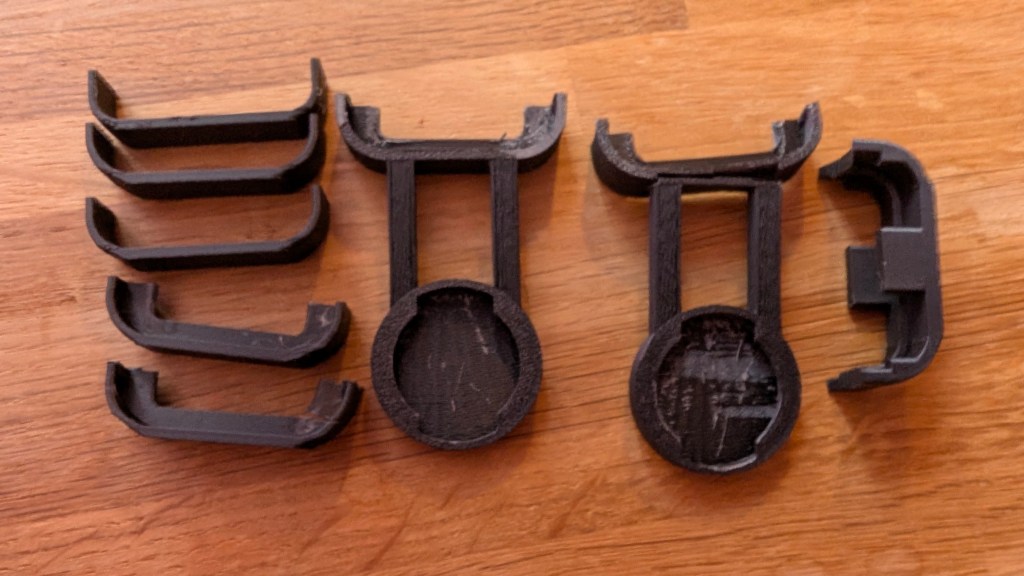
With a lot of my designs, it’s like solving a Rubik’s Cube.
There are constraints, requirements, ideas, and tradeoffs—none of which seem to fit together.
But after a few iterations… something shifts.
Things start to click.
The parts lock into place.
And suddenly, it just looks right.
That’s the magic of iteration.
And it’s built on a mountain of suckcesses.
All the missteps, the puzzling, the head-scratching—it all means something.
Because when I finally reach a solution that works, it makes the whole journey worthwhile.
Sometimes, when I think about a new design, I know I have no idea what the final version should look like.
I just know there’s something to discover.
That means there are suckcesses and floppertunities waiting for me out there.
And yeah, that can feel daunting.
Because I know it’ll be hard. I know it won’t go smoothly.
But what’s the alternative?
That I don’t try?
Because if I don’t even try—then I definitely won’t get that success.
To me, a suckcess is a print that doesn’t work out…
but teaches you something that leads to success—maybe even in a totally different project.
Like those early hinge ideas that came from failed prints and sparked the 3D cards.
They didn’t “do the thing,”
But they gave me something better.
So what is a failure?
For me, it’s the one that doesn’t work and you don’t learn from it.
It’s when you give up.
It’s when you stop.
When you try something new, you don’t know if it’ll work.
You don’t have to celebrate the ones that don’t.
But you can learn from them—the suckcesses, the floppertunities, the beautiful misfires.
The fear of failure is always louder than failure itself.
You’ll imagine the worst.
You’ll hesitate.
But the only way to learn where the limits are… is to push past where they used to be.
You can’t always control whether something will be a success.
But you can control whether it’s a failure.
Take the shot.
Do the thing.
You only fail if you give up.
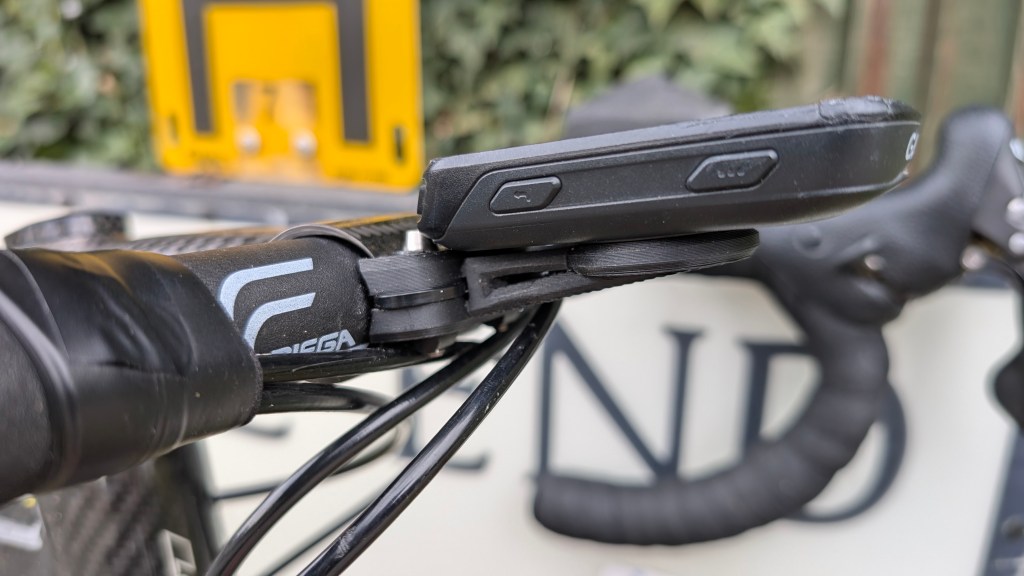
After a dozen suckcesses, this one stuck the landing. The Garmin’s not flying off anymore—unless I do.
 Davide la Locomotive
Leave a comment