
We scream on rollercoasters and call it danger.
We take real risks and pretend it’s normal.
This is a story about fake fear, real risk—and why authenticity is the scariest ride of all.
Corporate fun is a serious business.
At a company I was working for, we were marched off to Thorpe Park for an all-hands team-building day.
Enjoyment was mandatory.
Smiles were compulsory.
Fail to laugh, and the fun police would taser you, lock you in a cell, and ask:
“Are you feeling frowny… punk?”
You will be.
We had an early-bird pass, so we got to ride the rollercoasters for a couple of hours before the big queues.
Everyone screamed.
Hands in the air, faces twisted in terror and delight.
I’d never been on a rollercoaster before.
I just sat there, getting jolted around like a sack of turnips in a wheelbarrow.
It didn’t feel dangerous. It didn’t feel scary.
It felt… fake.
I looked around, wondering why everyone else was screaming.
They said, “It’s scary!”
It wasn’t.
And for years, I thought maybe I was the weird one.
Now I’m not so sure.
Maybe pretending you’re in danger when you’re absolutely not is… actually kind of weird.
Like group hysteria.
A sort of agreed-upon lie.
And I don’t know why you’d want to lie to yourself like that.
After two hours, I’d had enough.
I walked back to the little monorail that takes you from the rides to the entrance.
I was the only person going the wrong way.
They had to send a train out just for me.
I sat at the front with the driver.
He asked, “Did you forget something?”
I said, “No. I’ve had enough of rollercoasters.”
I walked back to the hotel.
Got my bike.
And rode to my parents’ house for a BBQ.
A few hours later, I cycled back in time for the evening meal.
People asked where I’d been.
“I went to a BBQ.”
They thought it was hilarious.
The company didn’t. Apparently, I didn’t have the right kind of fun.
I couldn’t work out why people were screaming on the rollercoaster.
Rollercoasters are meticulously designed, over-engineered, and obsessively maintained. Every bolt, angle, and restraint is planned to keep you alive while you scream like you’re about to die.
It’s called “benign masochism”—an experience that simulates danger or discomfort, but in a completely controlled environment.
It’s the same reason people watch horror films, eat ghost peppers, or listen to sad songs when they’re happy.
Want to guess what the safest form of transport is?
It’s flying, everyone knows that (0.07 deaths per billion miles)
Rollercoasters (3.2 DBM) are as dangerous as driving (3 DBM).
Do you throw your arms in the air and scream whilst driving?
Me neither.
You are far more likely to die walking (27 DBM) to the rollercoaster.
And then there’s cycling (24 DBM).
Not because it’s inherently dangerous—
but because cyclists are exposed. Vulnerable. Easy to ignore.
And yes, wingsuiting is far worse.
But it didn’t make the team-building shortlist. Probably something about liability.
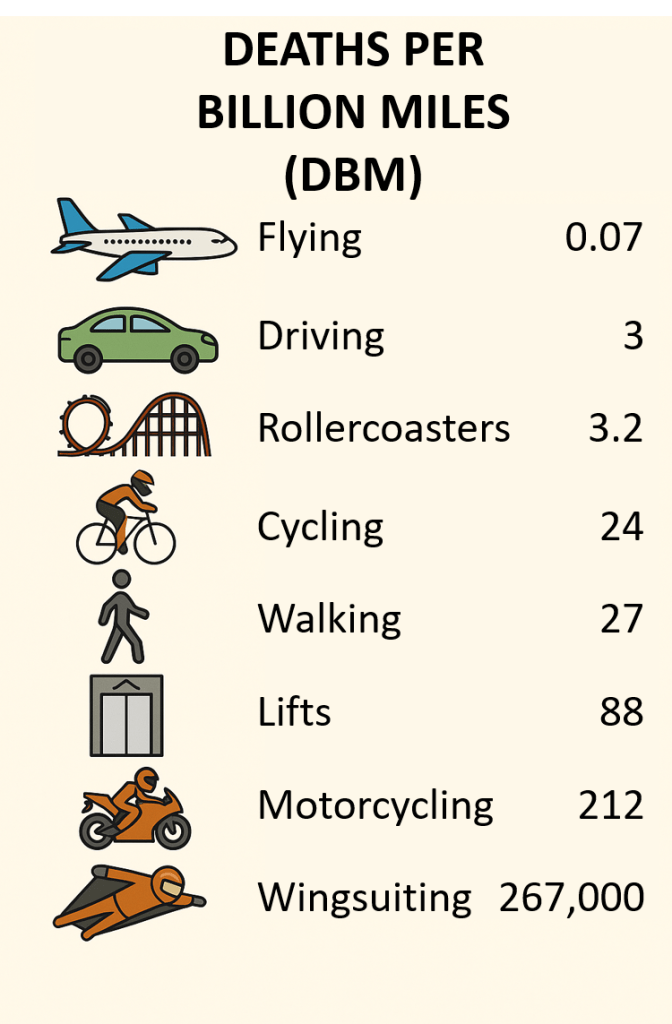
Sources & Calculations
Wingsuiting — Human Bird Wings
Fatality rate ~1 in 500 jumps
Average glide ratio 3:1 from ~4000m altitude = ~7.5 miles per jump
→ ~267,000 DBM
Flying — Risk Know-How
Estimate: 0.07 deaths per billion miles (DBM)
Rollercoasters — BBC Travel
~4 deaths per year, 1.7 billion rides annually. Average ride length ~0.74 miles → ~3.2 DBM
Driving, Walking, Cycling, Motorcycling — UK Government Road Casualties Report (2023)
Driving: 3 DBM
Cycling: 24 DBM
Walking: 27 DBM
Motorcycling: 212 DBM
Lifts (Elevators) — Miller & Hine Law
12 deaths per 18 billion trips
Typical trip distance: 4 floors (~40 feet or 0.0076 miles)
→ ~88 DBM
You want to know what real fear is?
Try weaving through Cambridge during rush hour.
Vans cutting you off. Buses breathing down your neck.
One time, a Tesco delivery driver looked like he wanted to drive over my head just to make a point.
It’s not that I don’t feel fear.
I do. And I’d rather avoid it.
I don’t cycle because it’s dangerous.
I cycle because I love the thrill of motion.
The freedom.
The flying feeling.
There are scarier things than cycling through traffic.
Things like asking someone out on a date.
Or going for an interview.
Or being different.
I’ve been screamed at on a bike. I’ve had road rage aimed at my face.
But emotional wounds cut deeper—and sometimes, they never fully heal.
A broken wrist is easy to x-ray.
A broken heart? Not so much.
Rollercoasters are designed to feel dangerous while being completely safe.
But the stuff that actually matters—
doing the things you love, changing jobs, telling someone how you feel, being yourself?
That’s the opposite.
Living an authentic life might be more dangerous than a rollercoaster.
But at least it’s real.
You can’t fake that.

 Davide la Locomotive
Leave a comment