
We often design based on our unconscious assumptions about how things should be. What happens when we challenge those assumptions?
I thought I was just designing lamps. Turns out, I was rebuilding how I think.
Introduction
Over winter, my office got a bit gloomy. I needed lights.
Just some simple lights.
No need to get all fancy or anything.
And definitely no reason to get sucked down a massive rabbit hole—questioning what makes a light a light. Why we think lights look the way they do. Then trying to create impossible-looking lights…
The Cuboid Lantern


I looked online, but nothing felt quite right—and the ones I did like were expensive. So I thought I’d design and 3D-print my own.
I started simple: a Japanese-style lantern. Just a cube with a warm glow. Printed in wood-textured filament (fake wood, real vibes). The diffuser looks like frosted glass but it’s white filament printed thin enough to glow.
I added some geometric details inspired by Rennie Mackintosh—because with 3D printing, complexity is practically free. Once the design exists, the printer doesn’t care how intricate it is. You can make things you’d never attempt with real wood, and it still feels handcrafted… even if your hands never touch a chisel.
Mental Models: Invisible Rules, Visible Light
I started thinking about the light I had just created. Why had I designed it like this?
We all have invisible rules in our heads—assumptions about how things are supposed to work. They’re shortcuts we build from experience. They simplify things to help us make sense of the world without having to rethink everything from scratch.
These are called mental models — basically, instruction manuals we didn’t know we downloaded.
And apparently… I had one for what a light was.
Somewhere in my brain, without even realising it, I had many assumptions about what makes a light.
But now—with LEDs, a 3D printer, and complete design freedom—why was I still making cubes?
I realised that the mental model I had was restricting my thinking about the kind of lights I could design.
That’s when I started asking: how many of these assumptions are needed and how many can I break?
What kind of weird lights could I create if I threw out these assumptions?
2-Axis Lights AKA The Retro Cylinder
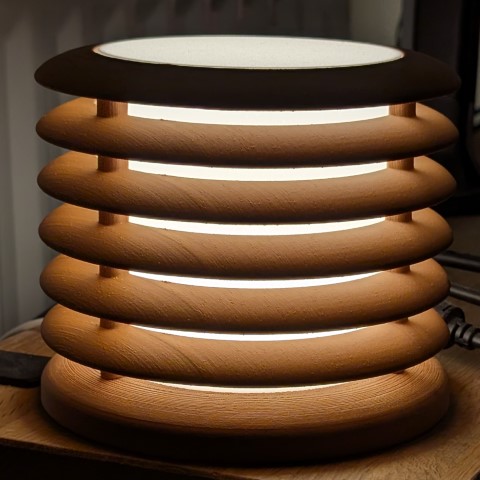

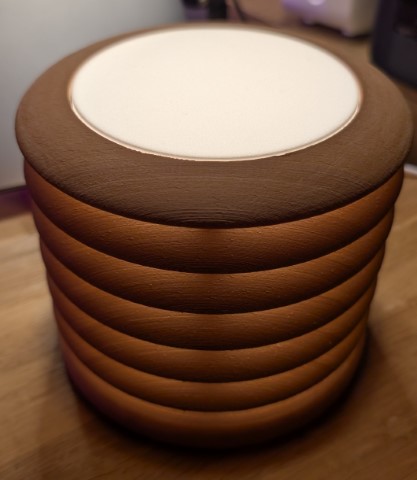
So I started thinking about pulling at the edges of my own rules.
I saw a light on eBay made from an old Bakelite radio. They’d gutted the internals and stuck in a bulb. It was a little rough—chipped, holey, cobbled together—but it had something I liked: curved fins stacked vertically around a semi-circle. Retro. Space-age. Cool.
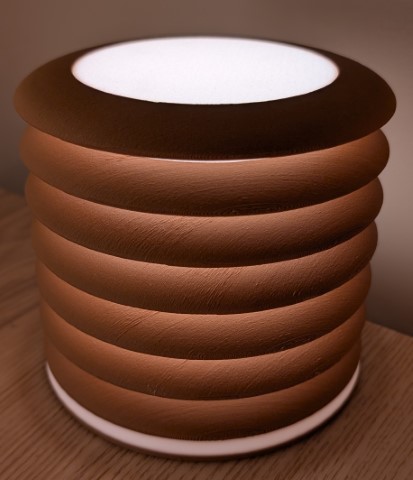
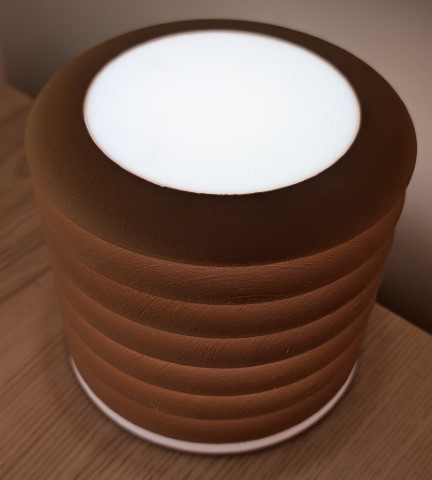
So I made my own version: a modern take, cylindrical, printed in wood filament, with stacked rings and a diffuser inside. It looked good.
But when I thought about it, I noticed it still had some old-school lighting features—ones I hadn’t needed, but had included anyway.
Assumption #1: A Light Needs a Big Base
It had a thick base.
That made sense—back when bulbs screwed into sockets. But LEDs? No socket. No bulb. Nothing to hide.
Still, when I removed the base, it looked wrong. So I compromised. I kept the base, but made it hollow. I added a ring of light around the bottom. The LED sits above, and the light now bounces through the base rather than hiding inside it. The base became a part of the light show—not just architectural leftovers.
Assumption #2: Lights Need Visible Support
I noticed the support structures holding up the fins. They were fine, but predictable. Visible. Necessary-seeming. Boring.
But with 3D printing, I had options. I redesigned the diffuser to become the support. Hidden. Tight-fitting. Clean. I glued everything together—and suddenly, the fins looked like they were floating.
No visible frame. Just stacked rings hovering in space.
Assumption #3: A Light Should Have a Bright Spot
With traditional bulbs, the light isn’t even. There’s usually a bright core—right near the filament—and everything else fades outward.
However, I was using an LED panel—an array of tiny lights spread across a surface. Which meant no hot spot. No falloff. Just a soft, consistent glow.
And here’s the twist: It actually matched the mental image I had of what light should look like. But that made it look less like a “real” light.
Because my brain had been trained on bulbs. On brightness that screams from the center and fades like a memory.
So when the light came out perfectly even, it felt both familiar and unsettling.
And that’s the thing about mental models: they’re full of invisible “of course”-es.
- Of course the light needs a base.
- Of course the structure must show.
- Of course there’s a bright spot.
Until you stop and ask—what if it doesn’t?

3-Axis Light AKA The Spaceship
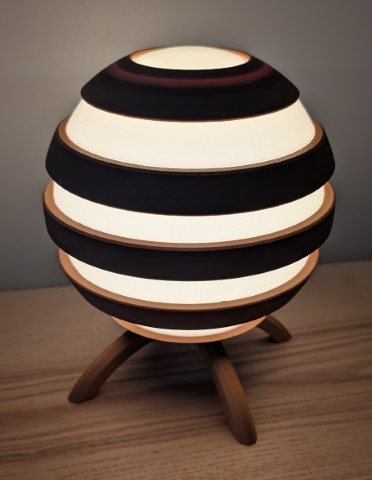


This next design wasn’t based on any light I’d seen. It came to me one evening while gazing at my lava lamp.
I imagined a glowing sphere—smooth, solid—with horizontal slats around it. The idea was to hide the light source within one of those slats. The LED I use is just 8mm thick, which feels almost impossible. But it fit.
And because all the slats are evenly spaced, the one holding the light disappeared into the pattern.
Assumption #4: Lights Have Visible Cables
We’re so used to seeing light cables dangling that we just accept it. Even when the light itself is beautifully designed, the cable is often left to drape out the bottom like an afterthought.
But I didn’t want that.
If the light is an object of intention—why stop at the edge? Why not design the cable’s path with the same care?
So I routed the wire down through one of the legs, hidden inside. Then I printed a custom cover, glued it in place, and used chamfers so the leg looked too thin to possibly contain anything.
It works. The illusion holds. People see a floating orb on elegant legs. No mess. No wire. No reminder that it’s plugged into anything at all.
It’s not just clean—it feels intentional. Like every part of the design respects the whole.
Originally, I had the legs short and rounded. But while editing, I accidentally typed in a huge number for the leg height.
I liked it. So I kept it.
That’s the thing I’ve found with designing in 3D: sometimes my mistakes give me better ideas.
Assumption #5: Lights Don’t Look Like Renders
The inner sphere isn’t real. Just slices—suggested by the gaps between slats. But because the slats align, your brain fills in the rest. It looks whole.
The diffuser doesn’t look like support. The slats appear to float. There’s no visible cable. The light’s too even.
It’s “too clean”. I sent pictures to my colleague. He thought it was a render.
It’s not a render, it just looks that way.
The weirdest part? It looks more like my mental image of a light than a normal light. And because of that, it feels almost surreal. Like an object from a dream.
I gave a couple of these to my neighbours. One called it “the spaceship.” Another said there is something hypnotic about it.
It’s not just me who thinks this.


The Originless Glow

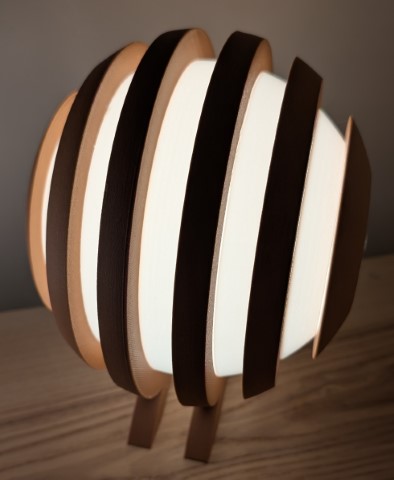

In most lights—including many I’ve designed—there’s an “origin.” A place where the light clearly begins. Even if you can’t see the bulb, you can tell where it’s hiding. The design points toward it. Anchors itself around it.
But I started wondering: What if the light had no obvious origin?
What if you couldn’t tell where the glow was coming from?
That’s when I discovered LED strip lights—a bendable ribbon of tiny diodes you can run anywhere. Which led me to my next design.
Assumption #6: Light Has An Origin Point
I wrapped a spherical diffuser in vertical slats and embedded the strip inside them. The slats became both structure and concealment. When the lamp is on, it glows uniformly. It feels like it’s lit from the inside out—but also from the outside in.
The effect is weird and wonderful: You can’t tell where the light is coming from. It’s not directional. It doesn’t emanate. It just exists.
The Spin Light
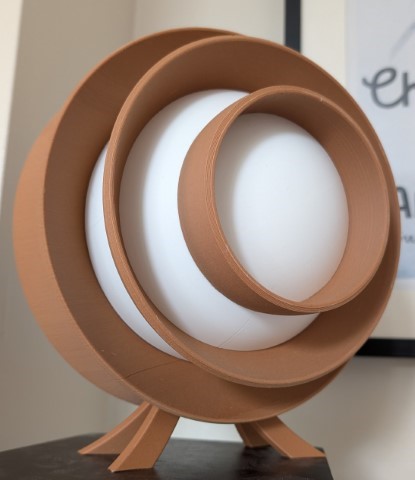
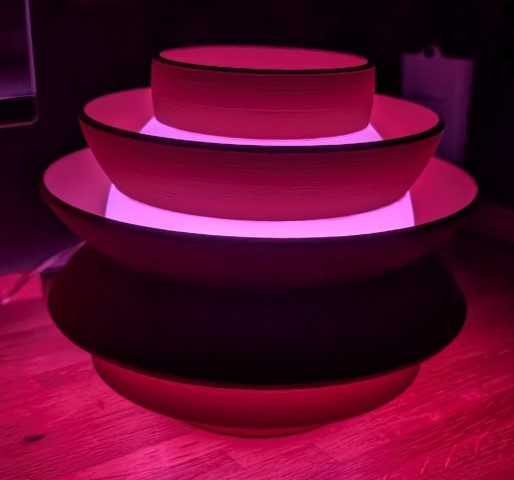

By this point, even ‘where the light comes from’ felt optional. So I asked: does light even need to stay still?
For the next design, I wanted to have curves everywhere. I’d used slatted fins before—but what if they arced instead?
Each fin in this lamp follows the same radius as the diffuser, just mirrored outward. That subtle repetition makes the shape feel natural—like the light grew that way, instead of being designed. It gives the whole thing a strange calmness. A feeling of rightness that’s hard to explain.
And then I added chaos.
Assumption #7: Light Is Static
I added individually addressable RGB LEDs—each one programmable. I printed a ring to hold them perfectly in position.

The light now moves. Not physically, but visually. The colours spin in patterns. Some modes react to sound. The lamp listens. It plays. It dances.

It feels alive.
The Orb Light
Right. So.
Naturally, my quest for simplicity somehow led to the most complicated thing so far.
Since I started designing lamps I really wanted to design something simpler, a lamp without the non-light bits. Not a shape wrapped around light. Just… light, suspended. Nothing extra. No fins, slats or patterning. No distractions. Just a glowing orb—pure, whole, untethered.
Which brings us to the final boss of light design…
Assumption #8: You Can’t Just Have a Literal Ball of Light
I wanted to make the simplest thing: a glowing orb. No structure. No base. Just light. But every real-world attempt cheated. Shadows. Dark spots. Support seams.
So I broke rules. And then I broke the things that enforced those rules.
The result? A sphere of light. A soul-egg on a tiny stand. It doesn’t roll off the table. It shifts colour like it’s thinking. It glows like it’s alive.
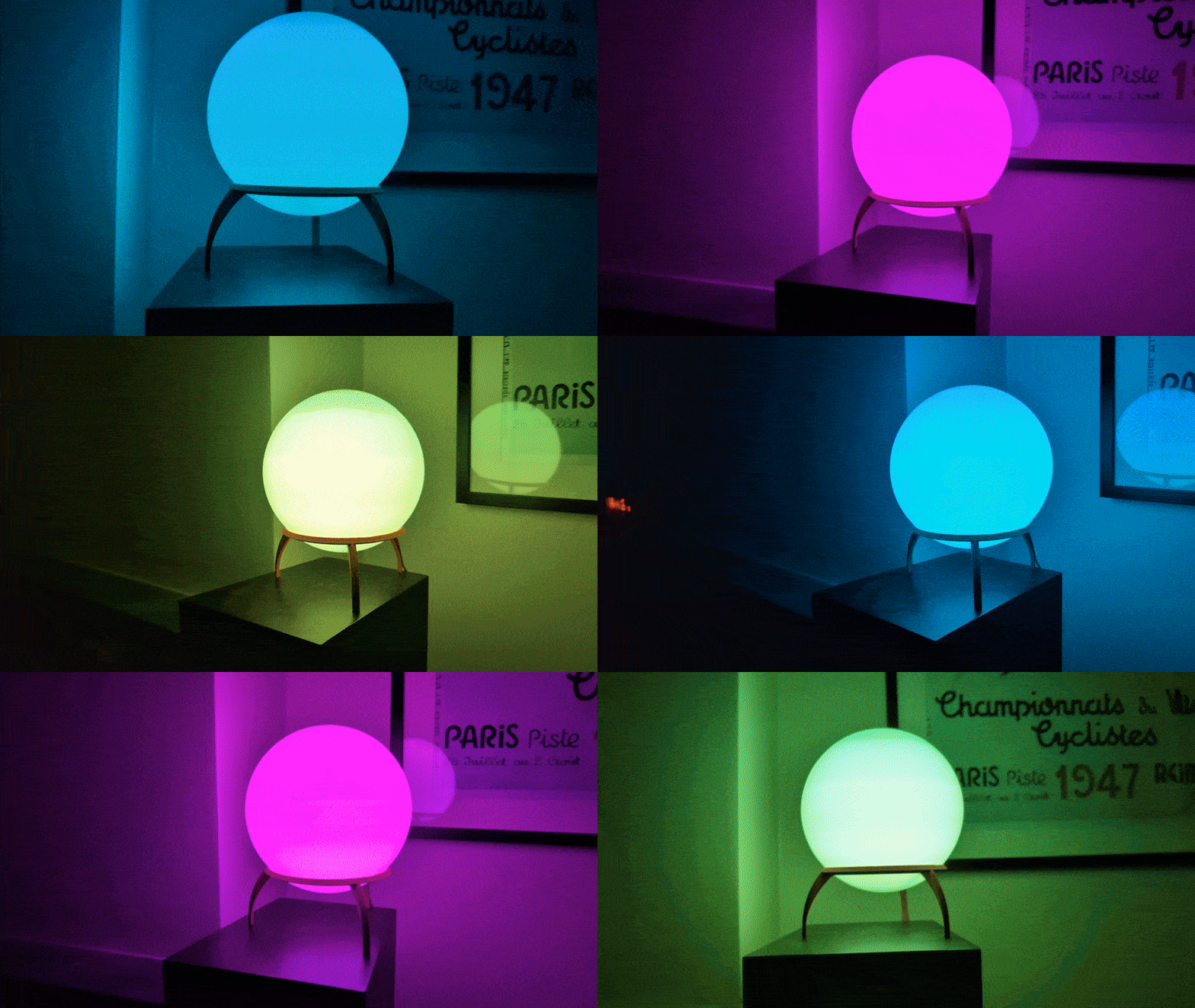
How does it work?
No comment. Got to keep some secrets.
The Floppertunities
Of course, not every idea works.
Some flop. Some fail interestingly. Some fail loudly.
But every misfire gets you one design closer.
- Spotlight Prison Escapee —A spotlight wrapped in glowing rings. Looks like it just broke out of a futuristic jail cell.
- Brutalist Cuboid with Rails — Inspired by LED strip lights, I accidentally built a Tron server rack.
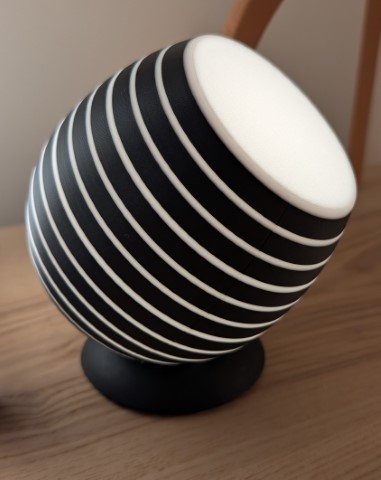
- Spiral Sphere —Gorgeous in theory. Physics disagreed. It took forever to print, longer to remove support, the spiral sagged — and my patience evaporated.



Breaking The Model
I thought I knew what a light looked like—until I started designing my own.
A mental model is an internal representation of something we think we understand.
We build them for everything—objects, places, people.
They’re shaped by habits, traditions, outdated truths, and comfortable guesses. They’re biased. Assumed. Inherited.
We build models to make the world easier to understand. But assumptions become constraints. And over time, the model becomes a box—one we don’t even notice.
Until we realise: we’ve been living in it.
My first manager used to say:
“All models are wrong, but some are useful.”
He was right.
But the trouble starts when we forget they’re just models.
When we start treating them as truth.
As walls.
As limits.
But we can do better than that.
We built the model.
We can break it.
And step out into the light.

 Davide la Locomotive
Leave a comment