
The seatpost snapped. Hope crumbled.
But I wasn’t done.
Enter CADrage, cursed geometry, chaos, and a certain French design prophet I had to invent just to have someone to blame.
It’s also, somehow, a love story.
Welcome back to PLA Hertfordshire — Carbon Crimes Unit.
In Part 1, I introduced Madame Maudite — my beautiful yet cursed 2006 Look 595 — and her frankly unhinged “e-post” seatpost system. After discovering a catastrophic failure in the carbon topper (and realising a replacement would cost more than the frame), I descended into the shadowy underworld of weird French engineering, obscure diamond shapes, and structurally optimistic 3D printing.
I gave it my all. I iterated. I modelled wonky bolt holes. And I rode V9, the first full version of my ePLA-post.
It broke.
Madame Maudite held me upright just long enough to feel like hope was justified — then sagged into a recline of despair.
V10
For V10, I needed to make the bolt slot bigger. I also switched to PETG — it’s stronger than PLA and comes in a gorgeous burnt titanium colour. This doesn’t make the part functionally better, but it does make it look like it thinks it’s better. Which is half the battle.
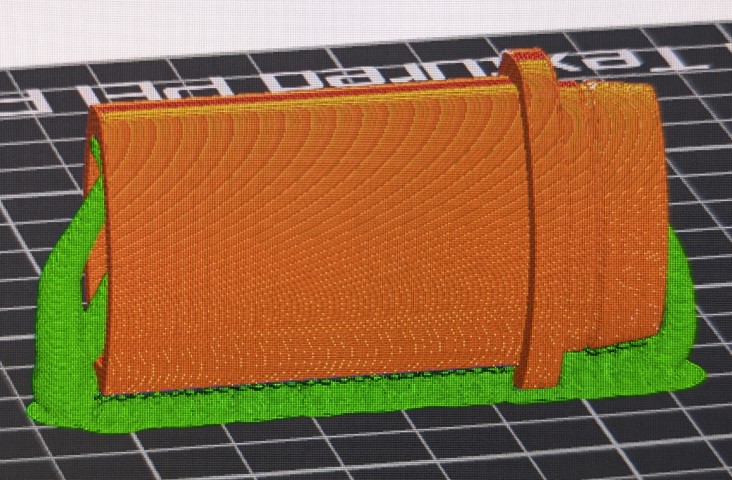
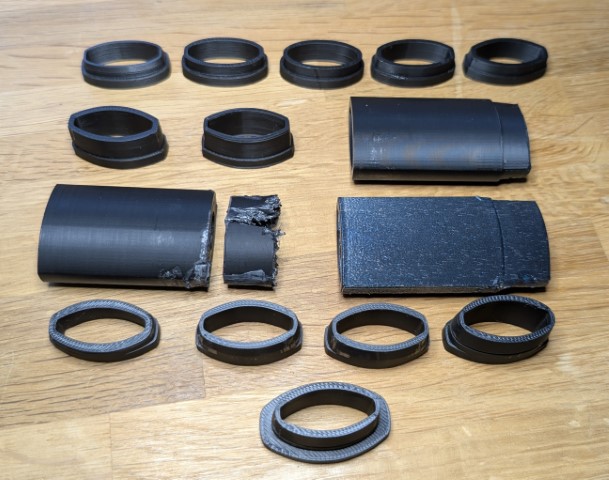
This time I printed it on its side. That makes it stronger against shear stress, since the high loads wouldn’t run across the layer lines. But side printing meant adding support, and removing that support took ages — like unwrapping a carbon-fibre mummy.
Still, I was cautiously optimistic. I saddled up and went for a ride…

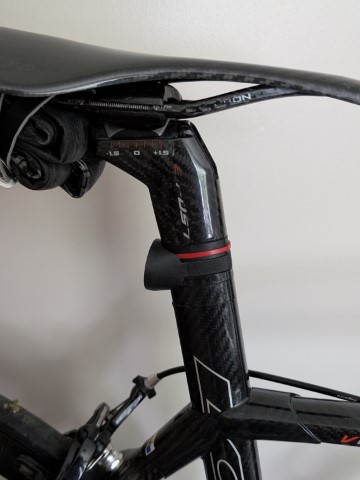
Ride Report
Good news first: I lived. Hooray.
Now for the not-so-good: I made it two metres.
The saddle wobbled immediately. It felt like the seatpost could just slide out… and it did.
On teardown, I found two issues:
- The hole inside the top part of the post — the one where my printed insert goes — was a different diamond shape. Of course it was.
- The expansion wedge was bottoming out before it could apply pressure to the elastomer. No compression. No grip. Seatpost go bye-bye.
Back to CAD. Back to iteration. Time to model this other diamond shape.
Because nothing says elegant engineering like weird diamond-on-diamond action.
The Storm Before the Calm
V11–V14
I began again, trying to model yet another ridiculous diamond. As I looked closer at the seatpost upper, I noticed the inside — where the splint needed to go — was misshapen. It didn’t have an inner ledge to rest on. It tapered unevenly. Nothing was square. Nothing made sense.
WTF?! Who designed this monstrosity?!
CADrage (n.)
/kædˌreɪdʒ/
Definition: The uniquely helpless fury that arises when a supposedly symmetrical part turns out to have been designed by a malevolent geometry goblin.
“Symptoms include shouting ‘WHY?!’ at a spline.”
Latin Motto: Figura absurda, furor — Absurd shape, rage.
I’d never experienced CADrage before. But I felt it rising — boiling behind my eyes like hot PETG.
I wanted to grab the original designer by the lapels and scream:
“Why did you design it like this?! What’s wrong with you?!”
To vent my fury, I had to invent him
Nostradumbass—my acutely obtuse nemesis.
Patron saint of proprietary suffering. Architect of absurd angles.
(Editor’s note: For those curious about the man behind the chaos, I’ve included an optional and deeply unnecessary Nostradumbass biography. Click to expand. You have been warned.)
Feral Geometry: The Shape of Things That Shouldn’t Be
Nostradumbass le Second — Keeper of the Wonky Bolt, Lord of Diamond Misalignments, Breaker of Saddles, and Master of Mild Inconvenience — who owned neither a set square nor common sense.
A prophet of pain, oracle of overengineering, and the patron saint of seatpost suffering.
He graduated top of his class from the École de Design Absurde, where he majored in Proprietary Interfaces and minored in User Suffering.
He was famously quoted as saying:
“Circles lack ambition. Squares are authoritarian. Diamonds? Diamonds are aspirational chaos.”
— Nostradumbass, sketching a parallelogram into a baguette crust
A committed shape maximalist, he rejected the tyranny of right angles and the predictability of curves. His magnum opus was the paralleloval — a parallelogram with rounded corners — which he proudly declared:
“The optimal shape for post-modern structural regret.”
As founder of Studio Parallelografique, he was a visionary designer, widely misunderstood by engineers, cyclists, and — well — anyone really.
His most successful invention was the parallantenna — a parallelogram-shaped radio aerial that “orients the lobes of signal energy in a quantum-ambiguous fashion,” dramatically reducing interference. Probably.
He also developed paralleloval-shaped bearings, which were significantly less successful and ultimately bankrupted the studio.
He lived in a massive rhombus-shaped house, perched proudly on its point — which he claimed was:
“The most stable shape imaginable. Spiritually, if not structurally.”
Tragically, the architectural marvel met its end during a light breeze in Provence. The house toppled like a rhombic Jenga tower. His final words, reportedly:
“It wasn’t the shape. It was the wind’s fault.”
He was survived by his wife and children: Kite, Poly(gon), and Calisson.
“We were never allowed to eat pizza. Too round. He said circles ‘betrayed the soul of geometry.’ At school, I had to cut my sandwich into rhombuses. The other kids called me Madame Parallellopain.
Now? I’m a potter. I spend my days shaping perfect circles on the wheel — bowls, cups, dishes. My studio is full of spirals and soft lines.
I serve pizza every Friday — on round plates.”
— Calisson Rondel née Nostradumbass
Nostradumbass is remembered for his enduring contributions to cycling, geometry, and catastrophic confidence.
His wife buried him in a round coffin.
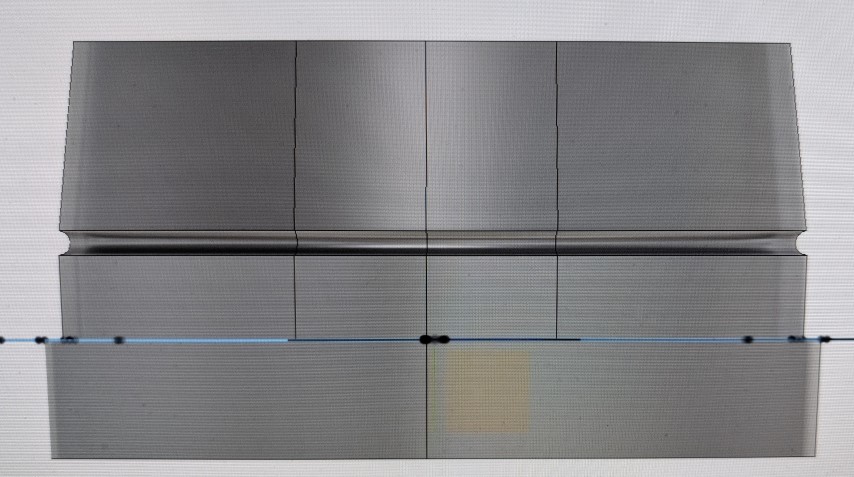
V11 through V13 were focused on modelling the inner paralleloval — the shape that fits inside the top piece.
Of course, it wasn’t the same as the outer paralleloval . Naturally.
paralleloval (n.)
/par.əˈlɛl.ə.vəl/
Definition: A shape combining the impracticality of a parallelogram with the smug roundness of an oval.
Usage is discouraged. By everyone.Example Usage:
“In 20 years, everything will be paralleloval: cars, mugs, mattresses… even babies.”
— Nostradumbass, moments before sketching a parallelogram into a crème brûlée crustOfficial Motto (as defined by Nostradumbass):
Forma regit rationem — The shape rules reason.Colloquial Motto (as defined by everyone else):
Ne feceris hoc — Do not do this.
V14 extended the taper and added a small relief ridge — so named because of the deep, visceral satisfaction it gave me when it clicked into place, like a cursed puzzle piece finally surrendering.


V15–V16
Now I needed to stop the splint from sliding too far inside the topper.
I considered adding a lip on the inside, but there was nothing for it to brace against — thanks, Nostradumbass.
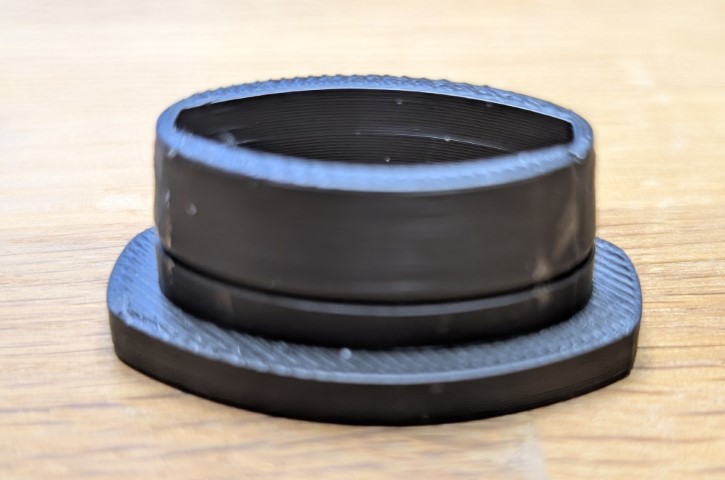
So instead, I added the lip on the outside.
It worked. The lip stopped the splint from disappearing into the frame like a sad carbon sword in a French stone.
V16 was the full build: splint, spacer, elastomers, the whole circus.
It printed well… but the inner insert came up short.
I didn’t want to waste another hour-long print, so I quickly designed and printed a shorter plastic spacer to take up the slack.
Everything slotted together. I fitted the post.

It was dark by this point, so I couldn’t ride it.
The next day, it rained.
By then, even the weather was conspiring against me.
I began to doubt it would ever work.
Maybe it’s just not possible to replace a carbon fibre component with a 3D printed one.
Maybe I was chasing a baguette-scented fever dream.
Ride Report
And then, the sun came out.
I went for a ride.
I started slow — gingerly, waiting for the creak, the crack, the inevitable French collapse.
But… nothing.
No creaking. No cracking. No dramatic list to starboard.
It was… fine.
I remembered how good Madame Maudite is to ride — so fast, so nimble, so sharp.
I love this bike.
I kept riding. The rides got longer. Faster. Still no problems.
I was so used to failure, I’d forgotten what success felt like.
At the weekend, I even printed extras: a new Garmin mount, a rear light bracket.
While I was at it, I removed the seatpost and had a look.
It was pristine.


Madame Maudite is back.
And this time, she’s holding strong.

The truth is, I didn’t just randomly buy this frame one evening.
I remember the first time I saw a Look 595. It was 2006. I was new to cycling — wide-eyed and broke — and the 595 looked like something from another world. Sleek. Sculpted. Unmistakable.
And that seatpost? Ridiculous. Iconic. Unforgettable.
I couldn’t afford one back then.
But I remembered. I waited. I searched.
Two decades later, I finally found her.
Originally, I’d wanted a white 595.
But white bikes are a nightmare to clean. So I went for black.
The bike I’d dreamed about.
The one that made me fall in love with design, and elegance, and the absurd brilliance of bikes.
They don’t make frames like this anymore.
Not hand-built in France.
Not with this level of ridiculous personality.
Not with enough quirks to write a whole novel.
And that’s exactly why I didn’t give up on her.
This wasn’t about a seatpost.
This was about memory. Craft. Value. Care.
I didn’t know about the seatpost nonsense when I bought her.
I built her up. Rode her for a few glorious months. Everything felt right.
Then one day, I took the seatpost apart.
I was curious. Careful-ish.
But I didn’t know what I didn’t know.
And when I put it back together, I got it wrong.
I broke it.
It was my fault.
And maybe that’s why I couldn’t let it go.
This wasn’t just about cursed carbon geometry or a stupidly thin wall inside a frame.
This was about a bike I’d loved for twenty years, finally in my hands… and broken by my hands.
So I tried. I printed. I failed. I redesigned. I failed again.
But I kept going.
Because when something matters, you don’t throw it away.
You fix it.
You ride it.
You forgive it.
Even if it never quite forgives you back.
I loved her before I broke her.
I’ll love her after I fixed her.
Even if she tries to fold herself in half again.
I could hang her on my wall and never risk another failure.
But what’s the point of that?
If it were me, I’d want to be ridden.
To create some great memories.
Even if it meant not being around in another twenty years.
She might not last forever.
But she doesn’t need to.
What matters is that she’s ridden.
And remembered.
Madame Maudite is a cruel and unforgiving mistress.
She makes my heart skip a beat — sometimes from awe, sometimes from terror — like when her seatpost folds back without warning, as if reenacting La Mort du Cygne on an A-road.
She keeps me on my toes — literally, when I’m left standing — and figuratively, as I try to predict her next caprice.
And yet, in her maddening fickleness, she is pure French chic.
Her carbon weave shimmers like couture.
Her internal routing is a masterclass in elegance.
She is fast.
She is agile.
She is a ballerina wearing cleats.
Yes, she’s temperamental.
But perhaps that’s the price of greatness.
And I wouldn’t change a thing about her…
…well, apart from that seatpost.

 Davide la Locomotive
Leave a comment