My stroke didn’t come with lightning or violins.
It came with a tape measure, some very confused limbs,
and me trying to explain to a 999 operator that
I was both the caller and the casualty.
There are some words that sound bad no matter how gently you wrap them: tiny bomb, trace amounts of radiation, minor stroke.
If I told you I’d had a minor stroke, you might imagine slurred speech, dramatic collapses, or dragging a leg. But honestly?
If I hadn’t told you, you wouldn’t know.
I walk, talk, type, and ride just like before.
But this is what happened…
The First Time
I think it first started two months earlier.
I don’t remember it well. I hadn’t been sleeping properly.
I woke up at 3am feeling sick. My right arm was tingling—pins and needles, like it was asleep—and I had a weird pain in my side.
I sat up for a while. Eventually I called 111. They said I was speaking slowly. I thought I was speaking normally.
They sent an ambulance. By the time it arrived, the symptoms had gone. They ran tests and said it was probably a trapped nerve.
I felt like a bit of a wally for calling. It didn’t feel like an emergency anymore.
The Middle Bits
Over the next few weeks, I had more strange episodes—short bursts of dizziness and nausea, sweat dripping down my face out of nowhere.
I figured it was dehydration. Or sleep. Or something.
I didn’t know these could be signs of stroke.
I didn’t connect them with the “trapped nerve” incident.
The Big One
It was a Sunday morning. I’d had a strange dream: just the symbols ] [ — nothing else. That’s never happened before.
I got up, felt okay, had breakfast.
I was about to go for a ride, but first I measured my hip—I wanted to buy new shorts.
I sat down.
And suddenly… my right hand wasn’t working properly.
It felt like my brain was sending the right signals, but the wires were crossed.
I looked at my phone and felt confused. I couldn’t remember what I was trying to do.
Then my leg felt weird too. I couldn’t control it either.
I thought: this might be a stroke.
I got up—nearly fell over—staggered to the kitchen, took an aspirin, then sat down and dialled 999.
I didn’t know if it counted as an emergency.
I told the operator, “I think I’m having a stroke.”
She said, “Are you with the patient?”
“…I am the patient.”
Apparently I didn’t sound like I was slurring my words—but I was panicked. They could probably hear that.
The Hospital
By the time the ambulance came, the symptoms were starting to fade.
I could move my hand and leg again—still not quite right, but better.
They took my ECG and blood pressure, said they weren’t sure, and offered to take me to hospital.
I said yes.
I was still a bit wobbly getting into the ambulance.
But on the drive there, I noticed I was back to normal. I could move everything.
When we arrived, I walked off the ambulance unaided.
I felt kind of stupid. What if it was nothing? What if they didn’t believe me?
But they did.
They took it seriously—because they know minor strokes and TIAs (transient ischaemic attacks) can vanish as quickly as they appear.
I had a CT scan within the hour.
They gave me aspirin, admitted me to the stroke ward, and told me I’d done the right thing.
Roast Dinners & Results
Later that afternoon, I was on the ward eating a roast dinner—hospital edition.
A doctor came over and said they’d reviewed my CT scan.
There was a small mark, yes, but… it might’ve just been a migraine.
Apparently, migraines can mimic stroke symptoms.
Slurred speech. Confusion. Even limb weakness.
I felt a bit embarrassed. I’d dialled 999 for a migraine?
But also—relieved. That would be a good outcome.
Then a second doctor weighed in.
They weren’t so sure. They thought it could still be a small stroke.
To settle it, they decided to keep me in and book an MRI.
An MRI would show the tell-tale signs of any minor strokes—tiny areas of brain damage you can’t always see on a CT.
It would also give a better view of the blood vessels in my head, which might help identify the cause.
So I waited. Ate roast potatoes. And tried not to Google too much.
Night Watch
That first night, it was hot—over 30 degrees during the day, and still warm long after sunset.
I had a bed near the window, left open to catch any hint of breeze.
Lying there, headphones in, staring out at the sky, I drifted off.
Just as I slipped into sleep, a nurse rushed over and shook me awake.
“Urgh, what is it?” I mumbled.
“Your heart rate dropped to 38!”
I tried to explain, still half-asleep, “Yeah… I cycle a lot. That’s normal for me.”
She squinted at me. “Okay… well, I’ll just do a quick ECG.”
This happened repeatedly during my stay.
Every doctor and nurse mentioned it.
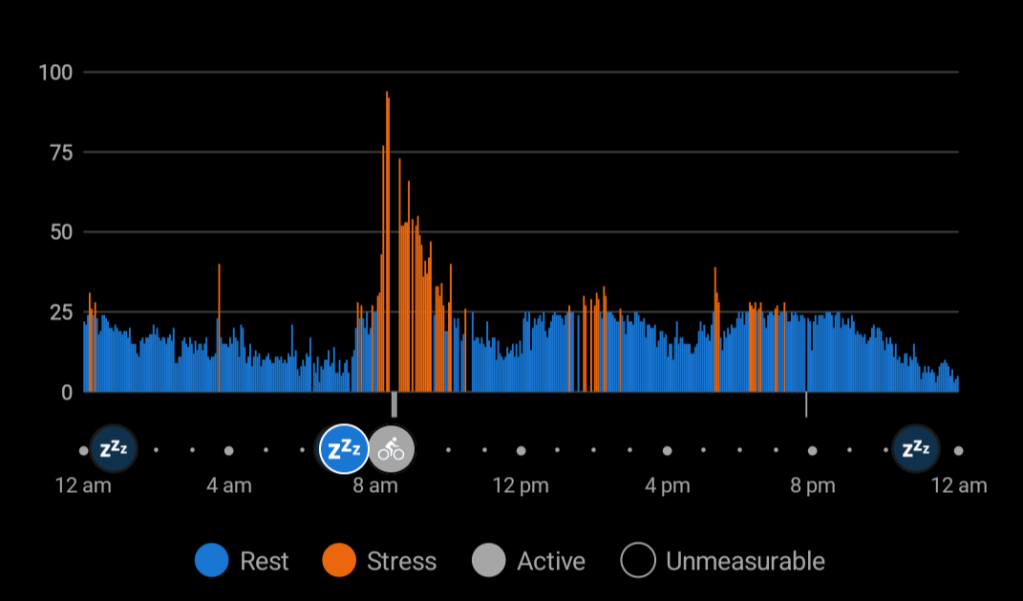
They’d be mid-conversation with me, eyes flicking toward the screen above my bed showing my heart rate—steadily sitting at 42 bpm—and you could see them trying to decide if I was fine or seconds from flatlining.
Second Day
In the morning, they said I’d probably have the MRI in the afternoon, then be able to go home.
So I waited.
Hospitals, it turns out, are oddly good for writing. I wrote a whole blog post.
I was on a ward with three other people. Visitors would walk in, see me sitting there, and do a double take. I wasn’t old enough. I wasn’t in a gown. I didn’t have any visible symptoms. I think some of them assumed I was just visiting too.
The afternoon dragged on.
Eventually, they wheeled me down for the MRI. It took a long time. The noise, the clanging, the stillness—it’s not painful, just… exhausting. I came out feeling drained and a little disoriented.
I hoped they might send me home after, but no. Another night.
They said the MRI results hadn’t been processed yet. But part of me suspected they had—and something in them meant I had to stay.
Because of the scan, I missed the evening meal. I asked if there was anything I could eat. They brought out a “special menu”—a secret list I hadn’t seen before, full of surprisingly decent choices.
I picked lasagne. It was actually pretty good.
But I was feeling low.
Hot.
Tired.
The ward hummed like a broken fridge. My thoughts started rattling in their own casing.
My body was fine but my brain was fraying around the edges.
I just wanted to go home.
Third Day
The next morning, I spoke to the doctor.
He told me the MRI had revealed tiny signs of stroke damage in my brain—small, but definite. And there was something else. They’d found a flap in one of my carotid arteries. It’s supposed to be a smooth tube. Mine wasn’t.
He said he was going to talk to the vascular team.
Later, he returned. The likely outcome, he said, was surgery. An operation on the artery to repair or remove the flap. It would be major surgery. It would leave a scar on my neck.
But it would fix the problem.
They thought it could be done in the next few days.
It was a lot to take in. On one hand: bad news. On the other: finally, an explanation. After weeks of strange symptoms and uncertainty, I now knew what was happening—and how to stop it from happening again.
Still, the thought of surgery filled me with dread.
It was the only way to stop more strokes.
And I knew I’d been lucky already—that the ones I’d had hadn’t caused serious damage.
That might not be true next time.
Another night in hospital.
With the heat, the noise, and the weight of everything…
That was probably my lowest point.
That night I lay staring out the window at the stars. I kept thinking about riding. About going forward even when the path disappears.
Fourth Day
It was becoming clear that the surgery wouldn’t be happening immediately. So the doctors decided to let me go home.
Finally.
The staff on the stroke ward had taken great care of me, but—let’s be honest—no one wants to stay in hospital longer than they have to.
I ordered an Uber.
I was exhausted.
But stepping into my house felt like breathing out for the first time in days.
About an hour later, the phone rang.
It was the vascular team.
They wanted me to come back in the next day—for an assessment.
My Lovely Veins
Early the next morning, I headed back to the hospital.
The vascular team are basically Dyno-Rod for humans—except they don’t show up in bright orange vans or leave you with a hefty call-out fee.
They clean out the plumbing, but it’s veins instead of pipes.
They had moved fast—they saw me first thing. I was booked in for an ultrasound so they could take a closer look at the veins in my neck.
They told me I had lovely, supple veins—which, flattering as that was, actually made it harder to see what was going on.
(Still putting that on my CV though. “Lovely, supple veins. References available upon request.”)
Eventually, they gave me a diagnosis: a carotid web.
It’s a flap in the artery that can cause blood clots to form—exactly the sort of thing that can lead to a stroke.
They explained the procedure needed to fix it.
I said yes.
Not because I wasn’t scared — I was.
But I’d been living in the grey zone too long.
This was colour. Sharp, clear, terrifying — but colour all the same.
Luckily, they didn’t find any other issues. Just the carotid web.
One annoying flap, but everything else looked clear.
They told me it would be discussed at their weekly surgical meeting on Friday. I expected to hear from them maybe on Friday.
But they called me that same afternoon.
The surgery was scheduled. First thing Monday morning.
I had phoned 999 on Sunday.
And exactly eight days later, I’d be on the operating table.
That’s seriously impressive.
They said I could ride my bike over the weekend.
So I did. A few last pre-surgery rides—my own way of preparing.
Don’t ignore the small stuff
Strokes aren’t always thunderclaps.
Sometimes they’re a pinprick. A whisper.
A tiny clot, tucked inside an artery.
It’s easy to brush off symptoms when they seem minor.
A strange feeling in your hand. A dizzy spell. A fleeting confusion.
It feels too small to matter.
But small things build momentum.
A tiny clot can change your life.
That little doubt? Might be your only warning.
If something doesn’t feel right—don’t wait.
You don’t need to be sure.
But you do need to act FAST.
Because strokes don’t ask permission.
By the time you notice—
you’re already riding that road.
The Wrong Road
I woke on a road I’d never seen,
no signs, no choice, just fields of green.
Not a route I’d like to know,
but here I am, miles to go.
The wheels hum low, the climb is steep,
wind too still, silence too deep.
No rhythm here, no known ascent —
just every turn a strange event.
The way unclear, the daylight strange,
fluorescent skies that never change.
Can’t turn round, no going back,
just forward down this winding track.
I ride, unsure, but not alone,
by misty fields and weathered stone.
Somewhere past the final bend —
a different track, a way to mend.
A road appears through softened haze,
a path I knew in brighter days.
With my wheels still spinning free,
I’ll find a trail that leads to me.
This is Part 1 of the story. Part 2 covers the surgery—and everything that came next.
 Davide la Locomotive
Leave a comment