A short introduction to stories that stayed weird for a reason.
Recently I’ve become fascinated by the Grimm fairy tales.
On one hand, they often don’t make much sense. They skip bits, end abruptly, or wander off down strange little side paths. Stories can shift from horror to happy ending in a single sentence. Characters act inconsistently. Sometimes an old woman just appears, clutching the exact magical flower needed to move the plot forward.
They really could’ve used an editor. And honestly? Some of them just aren’t very good.
But on the other hand — they completely ignore the usual storytelling rules.
They’re unpredictable, eerie, full of strange setups and vivid, feverish imagery.
So many read like dreams that forgot they were supposed to make sense.
Weeks after reading one, I’d still be haunted by a single image.
You find yourself thinking about strange shoes, cursed songs, impossible forests.
You forget how the story ended, but not how it felt.
That’s what gives them their haunted, dreamlike power.
They’re like puzzles worn smooth by too many hands.
Like bits of folklore caught mid-transformation.
Like ghost stories that forgot their own ending.
The Brothers Grimm didn’t write these stories.
They collected them — mostly from farmers, servants, and village women in the 1800s.
By the time the tales reached their notebooks, they had already passed through countless voices. And the Grimms themselves revised and edited the stories over several editions.
Some stories are a mishmash.
A strong idea is buried in filler.
A dark moment is followed by a jarringly cheerful ending.
Sometimes it feels like you’re reading two stories stitched together with stubborn hands.
And yet… look at the list of tales we still know:
Cinderella, Snow White, Hansel and Gretel, Rumpelstiltskin, Rapunzel, Little Red Riding Hood.
These tales have endured. Not because the plots were flawless — but because the images were unforgettable.
A poisoned apple. A slipper of glass. A gingerbread house in the woods. “What big teeth you have.”
They linger because they feel both real and unreal — close enough to touch, but just out of reach. The characters are recognisably human: jealous sisters, vengeful stepmothers, children trying to survive. But they live in a world of talking animals and impossible shoes.
It’s the uncanny valley of storytelling.
And it’s exactly that blend of the familiar and the strange that makes them so sticky, so adaptable, so dreamlike.
These are cultural landmarks — passed through generations, reworked by Disney, told again and again.
But the versions we know are not the originals.
They’ve been simplified, softened, sanitised.
Let’s be honest: no movie studio is going to release the original Grimm version of Snow White.
When I first started reading the tales, I expected princes and castles and ball gowns.
But the reality was far stranger — and more compelling.
There wasn’t always a happy ending.
Sometimes there wasn’t even a point.
But buried inside the mess, there were moments of truth.
Sharp, strange, unforgettable moments.
I don’t think the Grimms were trying to tell neat stories.
They were trying to preserve something.
But they didn’t always preserve the essence.
And that’s why so many of the tales feel like they lose their way.
Some stories ramble or collapse under their own weight.
But inside the mess, something glints.
A strong idea is buried under randomness. A vivid image gets lost in a plot that doesn’t know where to go.
And when the shape of the story doesn’t match its emotional core — something’s lost.
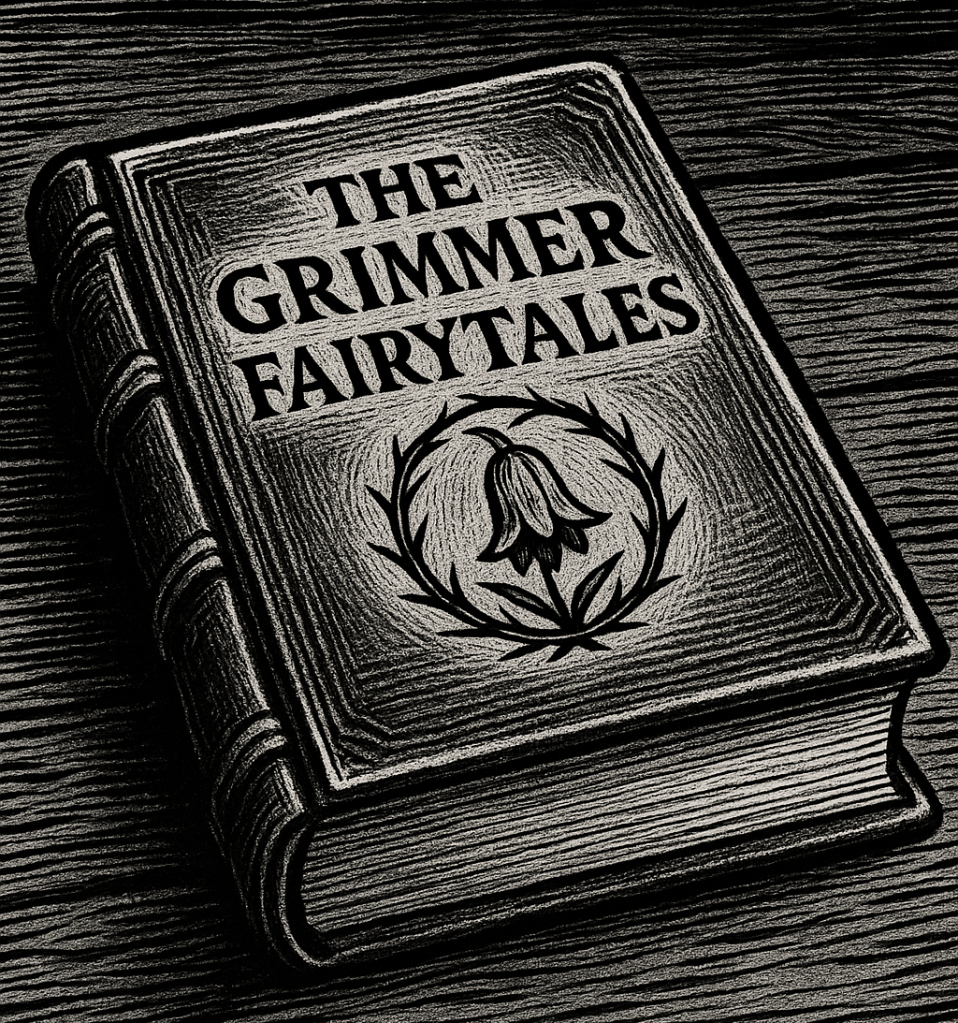
This is where the idea for The Grimmer Fairytales came from.
I don’t claim to be restoring the original versions.
I can’t — the people who told them are long gone.
The meanings have blurred. The edges have worn away.
But I can start with what’s still brilliant —
the dark images, the eerie energy, the emotional charge —
and rebuild the story around it.
I’m not here to modernise the tales, parody them, fix them, or force a tidy moral.
But I’m not preserving them in amber either.
I’m trying to let them work.
I am reshaping them — gently — to make them feel like stories again.
The kind that echo. The kind that land.
To let the story feel true — even if it never was.
To make emotional sense — even if it stays strange.
The weirdness isn’t a flaw. That is where the truth leaks in.
Sometimes I follow the plot.
Sometimes I follow the mood.
Sometimes I just follow the shadow of a single idea.
I don’t change much. The bones of the stories stay the same —
a sparrow still takes revenge, a sausage still dies,
a prince still tries to buy a beautiful corpse.
But when you strip away the polish, the meanings shift.
What was once a moral becomes a mirror.
These fairytales don’t always end happily.
They’re not meant for a children’s cartoon.
But then again — neither were the originals.
The Grimm’s fairy tales are strange, gruesome, cruel and dreamlike.
But sometimes when you look inside this absurdity, you find a truth.
Not a literal truth but an emotional one.
 Davide la Locomotive
Leave a comment