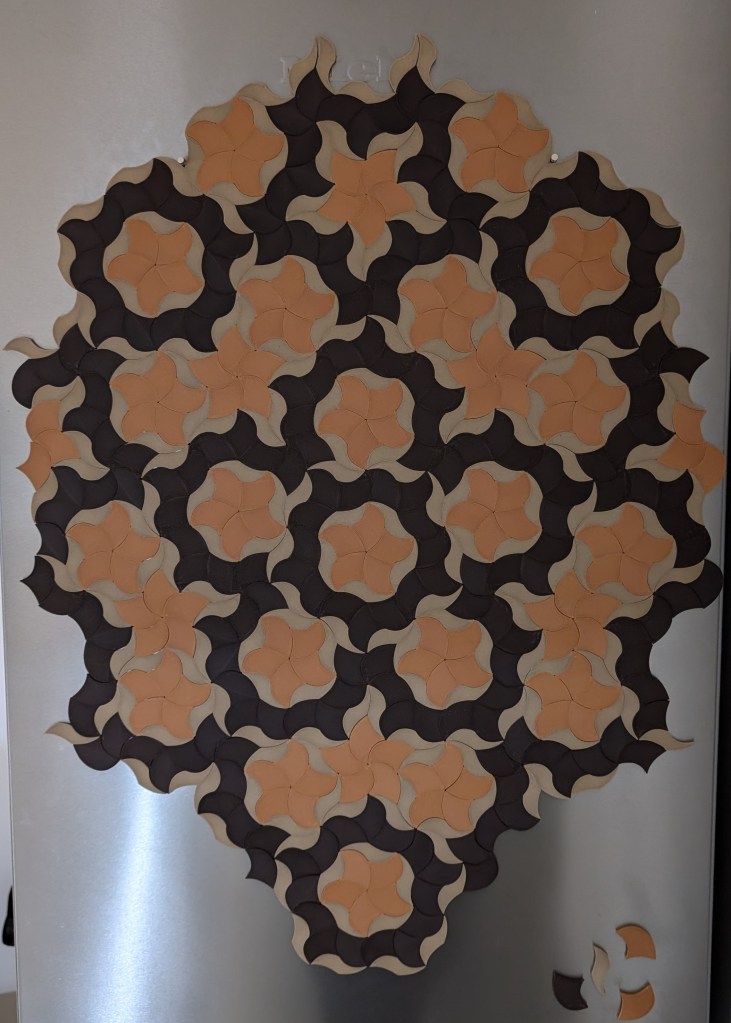
I thought I’d just made some fridge magnets.
But I might have accidentally opened a portal to another dimension.
One where I’m… an artist.
Am I? What even is an artist?
Because if I am, then anyone can be.
This post is a journey.
From fridge magnets to self-doubt, geometry to aesthetics, and finally, to an algorithm.
For becoming an artist.
I think most people think art is about natural talent or divine inspiration. I used to think that too.
But, there is another way.
It was a few months after finishing the great fridge magnet quest (as ‘finished’ as 3D printing ever gets).
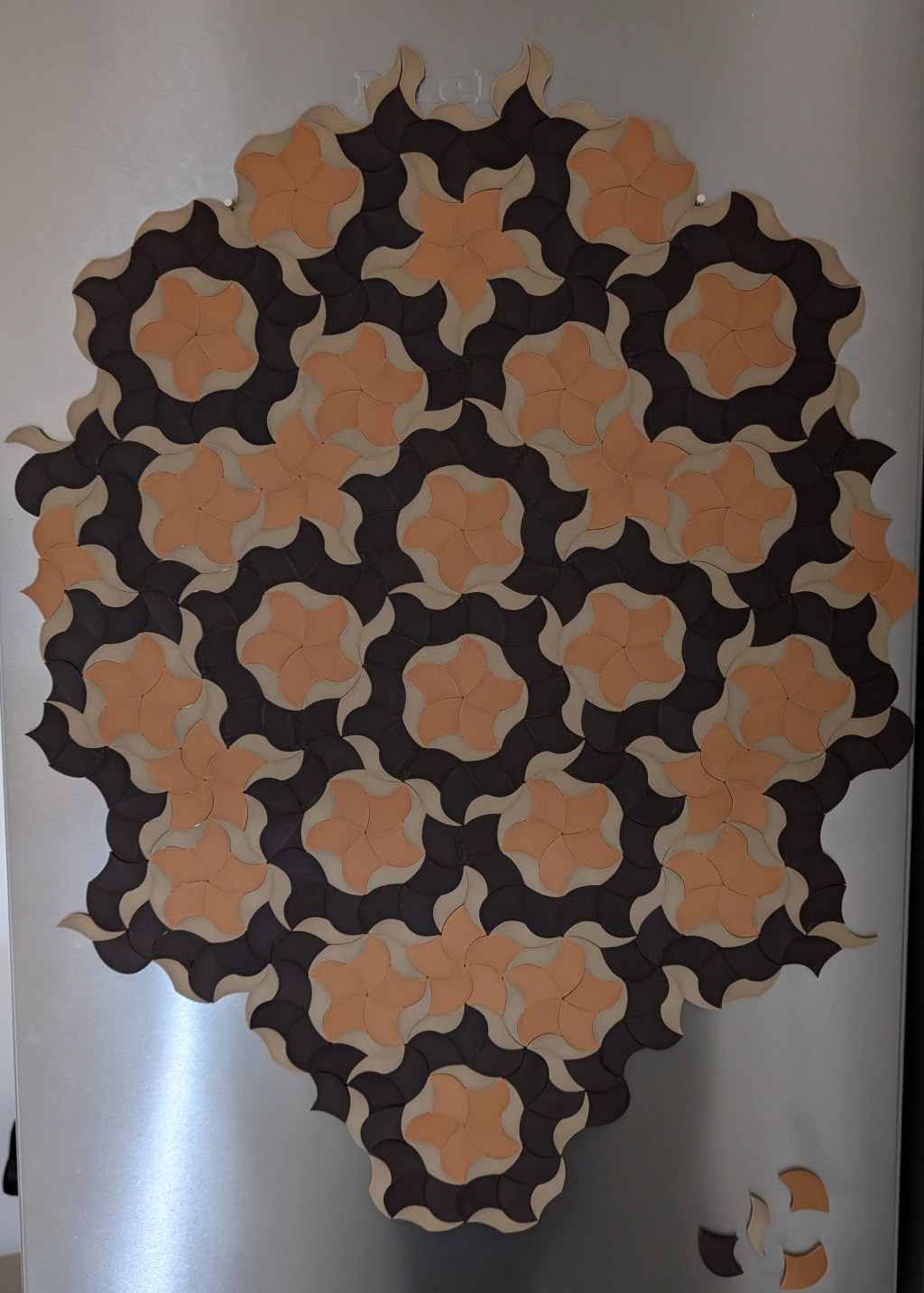
I still love my fridge magnets, in the morning light, the wiggly brown lines look almost alive — like tree roots creeping across the door. At night, under the kitchen bulb, the tiles flatten into matte shadow.
My neighbour came over—she has a degree in art. Knows her Hockney from her Haring.
She looked at the fridge for a long time, staring as if she was trying to solve it. Then she took out her phone and snapped a picture.
Then she said, “That’s art.”
I blinked. “No, it’s a non-periodic tiling pattern,” I explained, as if that cleared things up.
She said it again, slowly, as if I hadn’t understood: “It’s art.”
I looked back at the tiles.
They did look… strangely natural. Pretty.
At first I was thinking “nope”. But then I thought—wait. Could it be both? Did I just commit some art? Am I an artist?
First we need to figure out a few definitions.
Art is anything with aesthetic or expressive intent. A child’s scribble can absolutely be art — it’s expressive, spontaneous, and real.
The difference isn’t what gets made, but how it’s made.
A child typically scribbles without thinking much about colour or composition.
An artist starts making those choices deliberately.
That’s why art can be easy to create —
but becoming an artist is something you grow into.
Penrose tiling isn’t art. It’s a geometric pattern. A mathematical discovery. A set of shapes that just so happen to fit together in a weird and wonderful non-repeating way. It’s clever. It’s beautiful. But it’s not art.
When I started making fridge magnets using Penrose tiles, I wasn’t thinking about art. I was thinking about patterns. About cool maths. About finally solving the eternal fridge magnet problem.
But then I chose colours. And chose the shape and curve. I adjusted orientation, layout and texture. I tried things that looked bad, then changed them until they didn’t. I did it deliberately because I wanted it to look nice.
At some point, without even noticing, I had stopped making tiles…
… I had started making art.
I only realised it later, flicking back through the sequence of photos I’d taken while laying out the pattern. At first it looked clunky, even ugly. Then somewhere along the way—without me spotting the exact moment—it crossed an invisible line. From meh to yeah.
At some point, without meaning to, I crossed into territory people label as ‘artist’. I didn’t notice when it happened.
That still feels alien to me — like finding “Artist” accidentally scrawled on my job title, in someone else’s handwriting.
It still feels a bit odd to think of myself like that. To be clear I don’t have a degree in art or make money from art.
But neither do many artists.
I always thought being a “real artist” meant having some secret magic to learn. But it’s not like being a mathematician. With maths, doing a bit doesn’t make you a mathematician. There are theories, proofs, exams. Gatekeepers.
But with art? You make a thing. You look at it. You make it better. And suddenly, you’re in.
I began wondering. If I’m an artist. And I don’t see myself as having a special art skill, could anyone become an artist?
After much serious thought, zero peer review, and exactly one ham and cheese sandwich, I developed a foolproof system…
So here it is—my iterative method to becoming an artist. Guaranteed*.
*Guarantee not legally binding. Side effects may include: sudden strong opinions about colour palettes, increased turtleneck ownership, saying “this piece is about duality” without explaining further, and (in rare cases) death. Please consult your inner critic before use.
The Only Requirement is that you must have, at some point, looked at something and thought:
“Ooh, that looks kinda nice.”
or
“Ugh, I don’t like the way that looks.”
If that’s happened even once in your life—congrats, you’re already 90% of the way to becoming an artist.
The other 10% is the persistence to keep trying.
There are some other nice to haves like a deep understanding of numerical methods and iterative optimisation algorithms, but don’t worry, I’ve done that bit so you can skip it and keep the magic.
Introducing the A.R.T.I.S.T. method — the Algorithm for Recursively Trying Ideas in Search of Tastefulness (If you prefer a less silly name, you can also call it the Incremental Selection Algorithm. But let’s be honest: A.R.T.I.S.T. sounds cooler.):
- Do something. Anything. Draw a weird blob. Smear paint on a rock. Make a squid out of string. Design some fridge magnets. Doesn’t matter if it’s bad. Be random. Be chaotic.
- Look at what you made. Ask: “Do I like how this looks?”
✅ Yes? Boom. You are an artist! Welcome to the club.
❌ No? Excellent. You’re developing your taste. This is style formation in progress.
Proceed to the next step. - Find anything you do like. A colour. A curve. A shape. A texture. Even one tiny good thing.
- Keep those. Ditch the rest. Ruthlessly. Burn it. Sacrifice it to the muse.
- Return to Step 1, now with a bit more knowledge and slightly better taste. Repeat.
If you keep going long enough, people will start calling what you make ‘art’.
The only way you don’t is if:
- You give up. In which case, you clearly didn’t want to be an artist after all.
- You die. But you died “an aspiring artist”.
Now get scribbling!
You might think this algorithm wouldn’t work, it does.
Or that’s not how real artists work.
Are you sure about that?
Because artists do have processes with names like:
- Iterative refinement
- Taste-based progression
- Critical eye training
Which all sound a lot like the A.R.T.I.S.T. method but with a better/worse name (depending on whether you are me).
The difference between someone like me and a career artist is that:
- They might not realise the process that they follow
- They have been through this process thousands of times
- Over time they will have developed knowledge of things that will and won’t work AKA intuition, so they need fewer loops
But they’re still iterating.
Over time, your work catches up to your taste—
not because your taste got worse,
but because your skill got better.
This algorithm doesn’t just apply to art.
It works for photography. Writing. Fridge magnets.
Because in the end, becoming an artist isn’t about talent or titles.
It’s about having the courage to answer the question, “Do I like this?” honestly.
And the persistence to keep going until the answer becomes yes.
Every time I open my fridge, I see the pattern.
It still makes me smile.
It doesn’t feel like I made it — more like it appeared out of nowhere.
And it just… looks right.
Artistry can be engineered.
If you don’t believe me, come look at my fridge.
 Davide la Locomotive
Leave a comment