
A vintage French bike. A cursed seatpost. A spiral into rage, diamonds, and structurally dubious 3D printing.
This is how it began—with elegance, chaos, and a baguette-scented engineering nightmare.
I’ve never had a seatpost fail on me before…
Well, apart from that one time I over-torqued a £300 seatpost and obliterated it.
But I thought we agreed never to speak of that again. Jeez.
I never used to name my bikes, but I’ve decided to start.
In September last year, I bought a 2006 Look 595. I built it up, rode it for months, and then — of course — I started having issues.
This is the story of my odyssey through weird French design philosophies and infuriating proprietary seatposts.
I’ve named this bike Madame Maudite (“Cursed Lady”) — because she’s chic, agile, and temperamental in equal measure.
French Design 101
The French have designed some incredible stuff. Citroën invented hydropneumatic suspension — self-levelling, magic-carpet smooth, and able to drive with only three wheels.
Why would you need that? Nobody knows. I don’t think they even knew.
But they’ve also designed some utter nonsense. Like a floor-mounted rubber brake pedal where you had to stomp on a mushroom-shaped squishy button to stop. Why? Because they could.
Look pioneered ski-binding-style clipless pedals. Then they moved into frame design. And wow, did they go all in.
If I had to summarise French design in one phrase:
Stylish, inventive, and often impressive-looking — but with questionable practical applications.
The mid-noughties were a wild west of carbon fibre experiments. Bike companies were throwing ideas at the wall (and sometimes their customers) to see what stuck.
Enter the E-Post
Madame Maudite doesn’t have a regular seatpost. Oh no — that would be far too basic.
The frame is the seatpost. It’s called a seatpost mast. A short insert slides into the top, held in place with expanding elastomer wedges. It even flexes slightly — by up to 2.5mm — for “comfort.” It’s called an e-post.
Visually, it’s stunning. Seamless. Clean. There’s no visible clamp, no obvious boundary between post and frame. It looks like the whole thing was sculpted from a single monolithic piece of carbon.
Of course, this beautiful nonsense comes with drawbacks:
- You have to cut the seatpost mast to size.
- Adjustment range? Virtually none.
- Replacement parts? Proprietary.
- Selling it? You’ll need to find someone your exact size and level of French-flavoured optimism.
- Comfort? I ride a carbon fibre saddle. Pain is part of the experience. If I wanted comfort, I’d buy a Lexus.
Why did they do this?
Honestly? Because it looks cool.
And, 20 years later… yeah. It still does.
(As part of my research, I managed to uncover some “definitely real and absolutely not made-up” internal documentation from the mysterious French bike brand responsible for this design…)
Q: What if I cut my seatpost too short?
A: We’re happy to offer a part-exchange on your frame. You’ll receive full market value.
(Which is: zero.)

The Dying Swan Seatpost
One day, I noticed my saddle slowly sliding backward — like cycling on a chaise longue.
The seatpost had started reclining, swan-like.


Inside, I discovered the topper’s carbon inner sleeve — just 1.5mm thick — had come unglued.
I re-epoxied it, set out for a ride… and made it one metre before it folded itself in half like a convertible roof.
A £300 replacement?
Absolutely not.
I wasn’t going to take this leaning backwards.
I had a 3D printer.
Some basic CAD skills.
And a truly worrying disregard for structural safety.
Q: Will you continue to support these proprietary components?
A: Of course, we will support it indefinitely. Until we change our minds.


The Curse Takes Shape
The design was ridiculous:
Plastic wedges, elastomer spacers, a bolt torqued to 5Nm. A weird, rotationally symmetrical, rounded diamond shape — not aerodynamic, not conventional.
I began rapid prototyping:
- V1: Too big.
- V2: Tapered, still no.
- V3: It fit! But too rounded.
- V4: Sharper corners, too large again.
- V5: Perfect. The cursed diamond was mine.
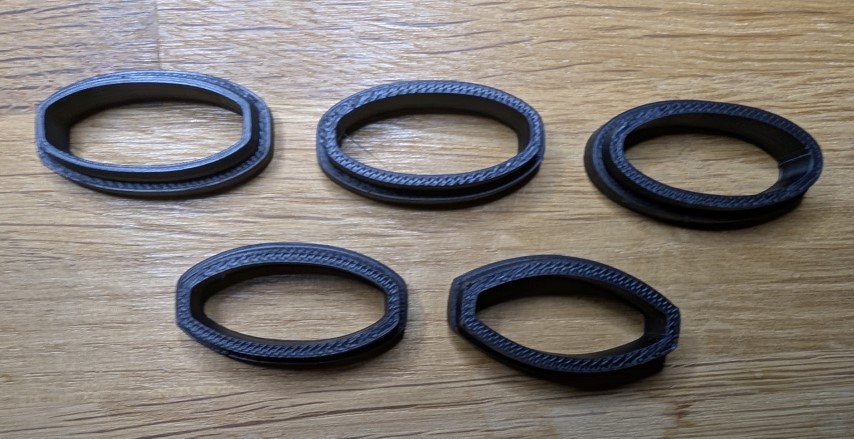

Now I could begin designing replacement parts.
Q: Why are the tubes symmetrical instead of aero?
A: We wanted a bike that’s equally aerodynamic going forwards as backwards.
Also, it means every part can be installed wrong — which would destroy your frame. So don’t do that.
Desperaflex™
A plastic spacer was broken. I re-modelled it perfectly.
Even better — I had red TPU filament. I could make my own elastomers too.
I named them Desperaflex™:
The flexibility of original parts, the desperation of aftermarket survival.

Now, onto the big one: the splint insert. It needed to:
- Support the broken area from inside
- Fit snugly into the carbon shell
- Accommodate the centre bolt
- Not explode
I iterated on it:
- V6–V7: Longer insert, refined taper. It worked.
- V8: Failed. I made the bolt hole straight — but it needed a 3° angle. Thanks, France.
- V9: Angled hole. Slotted for wiggle room. It fit. Test time.


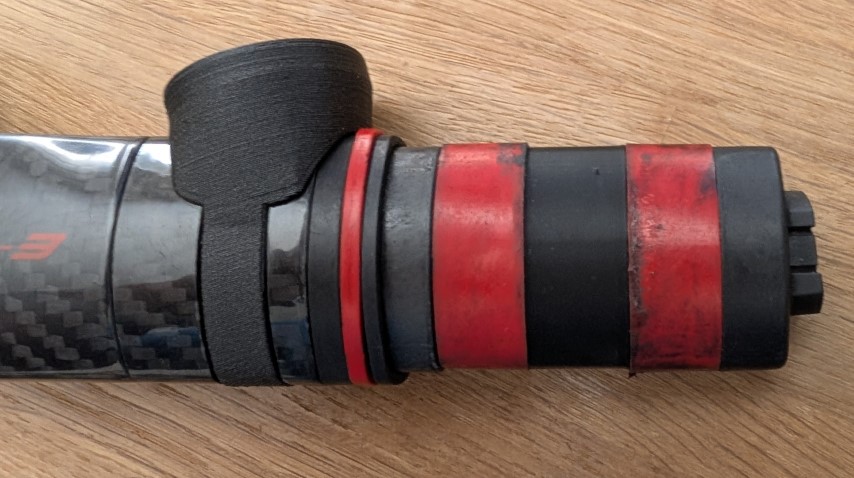
Ride Report
It sagged slightly. Then cracked.
Good news? Tight fit.
Bad news? Still broke.
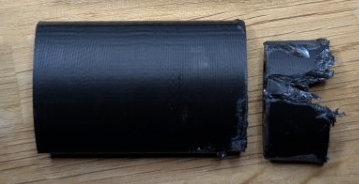
“Everyone has a plan until they get punched in the mouth.”
— Mike Tyson
And mine just got uppercutted by a cursed carbon trapezoid.
At this point, I wasn’t sure if this was going to work.
I wasn’t sure it could work.
Structural optimism met structural reality. Reality won.
structural optimism (n.)
/ˈstrʌk.tʃər.əl ˈɒp.tɪ.mɪ.zəm/Definition: The misguided belief that something held together by hope, friction, and questionable print settings will work perfectly fine.
Example:
“I was full of structural optimism until I heard a terrifying cracking noise and my seatpost began wobbling like a bendy straw.”Latin motto: Spes tenax structurae — “Hope holds the structure”
DÉGAGE™
The frame has acronyms all over it: HSCb, VHM, Compressa Carbon. None of which I understand.
So I made up one of my own:
DÉGAGE™
Deviously Éngineered to Gouge And Gatekeep Everyone
For cyclists who enjoy pain — financially and emotionally.
You wanted a bike.
We gave you a system.
And then we sold you the tools to fix it.
For a price.
But sometimes, with just enough rage and a 3D printer…
You can break the system instead.
Q: Why not just use a normal seatpost?
A: Because we wanted to reinvent the experience of rage-gluing your bike back together.
Proprietary Euthanasia
If you’ve ever browsed eBay, you’ve seen them — beautiful carbon frames for suspiciously low prices.
The listing says: “Just needs a seatpost.”
It doesn’t.
It needs a unicorn-shaped, one-season-only, diamond-sleeved magic rod made in 2006 and lost to time.
Bikes like this are everywhere. Frames that are perfectly rideable — if only you had that one part.
Instead, they rot. Abandoned. Forgotten. Not broken — just unsupported.
But they don’t have to stay that way.
A Love Letter in Carbon
Madame Maudite makes no sense.
She’s like a French arthouse film — full of ambiguous geometry and long, brooding silences as you wonder what’s about to snap.
She’s infuriating. She’s temperamental.
And yet, I love her.
I’m not giving up on her.
Je tiens bon.
I hold fast.
To my seatpost.
To my optimism.
To my cursed carbon companion.
In solidarity with Madame Maudite, I think it’s time to leave you standing — and break this post in half.
Not out of necessity, but for dramatic effect.
To be continued in Part 2
(Spoilers: There will be rage. A dumbass. And a confession.)

 Davide la Locomotive
Leave a reply to How I Beat Weird French Engineering and Became a Seatpost Whisperer – Davide la Locomotive Cancel reply