Major surgery, minor veins, and a stroke with a bruised ego.
In Part 1, I described a series of strange symptoms, a sudden minor stroke, and a hospital stay that led to a diagnosis: a carotid web. Eight days later, I was scheduled for major surgery.
I don’t like operations, and this was a major one. In the few days beforehand, I kept busy. I tidied up, stocked the freezer, prepped easy meals. I tried to channel the nerves into something useful. It was a strange kind of productivity.
I told a friend I didn’t want the operation. But it wasn’t really a choice. The decision was between doing the surgery—with its risks and scars—or skipping it and facing a much higher chance of another stroke. So I said yes.
I also decided that whatever happened, I’d try to make the best of it.
The Operation
I arrived at the day surgery unit at 7am. Checked in, sat down. Within minutes, they called me through. I was first up.
Gradually, I changed into a patient. Robe. Blue slipper socks. Watch off, phone away. The anaesthetist came to look at my hand, admiring my “lovely veins.” (Famous now.) Then I met the surgeon. As she left, I called out, “Good luck.” That was mostly for me.
The operating theatre was bright, antiseptic, metallic. Round lights on metal arms. Machines blinking quietly. Blue scrubs milling. Little metal tables with sharp things. And the table itself.
I lay down.
I was shaking.
They needed to put two arterial lines in. First, they numbed the area. It didn’t help much. Then came the needle—painful, but expected. What came next wasn’t.
They needed a line to control my blood pressure. A trainee, I think, was threading it in. I looked away. I hate needles. I could feel it catching, scraping inside. Like barbed wire dragged through a drinking straw.
“Watch your line,” the senior anaesthetist said.
I looked. Blood was spurting in rhythmic pulses onto my hand.
“Is this normal?” I asked.
It was not.
They gave up on that arm, tried the other. Same issue. Then back to the first. Five attempts in all. I just wanted them to knock me out.
Eventually, they gave me the pre-anaesthetic.
And then—
Recovery
I woke up in the recovery room. Everything hurt. My neck. My arms. My brain felt full of cotton wool.
“Open your eyes,” someone said. Then, oddly, they complimented them. I asked the time. Midday.
Relief: no complications.
The next few hours were blurry. By 3pm, I started to feel more like myself. Well, a sore, groggy version of myself.
The operation had been on my carotid artery, just below the ear. There was now a four-inch scar. It hurt to swallow. I drank warm water, then tea. That evening I ate curry. Tiny mouthfuls, slowly. It took an hour. But I had time.
Both anaesthesiologists dropped by to apologise for the drama with the arterial lines. Apparently, I have small veins. The surgeon came too, and said the operation was a success.
I spent the first night in the high-dependency unit. I had my own nurse, who seemed to scribble constantly. I’m not sure what they were noting—I was just lying there. The nurse changed every 12 hours. I didn’t sleep much. My neck was sore. Swallowing hurt. The neck drain pressed on my throat. And the other four people in the unit snored like a chorus of chainsaws.
The Ward
The next morning, I stood up for the first time. They moved me to a regular ward. The drain came out. The arterial lines came out. My arms were bruised and sore.
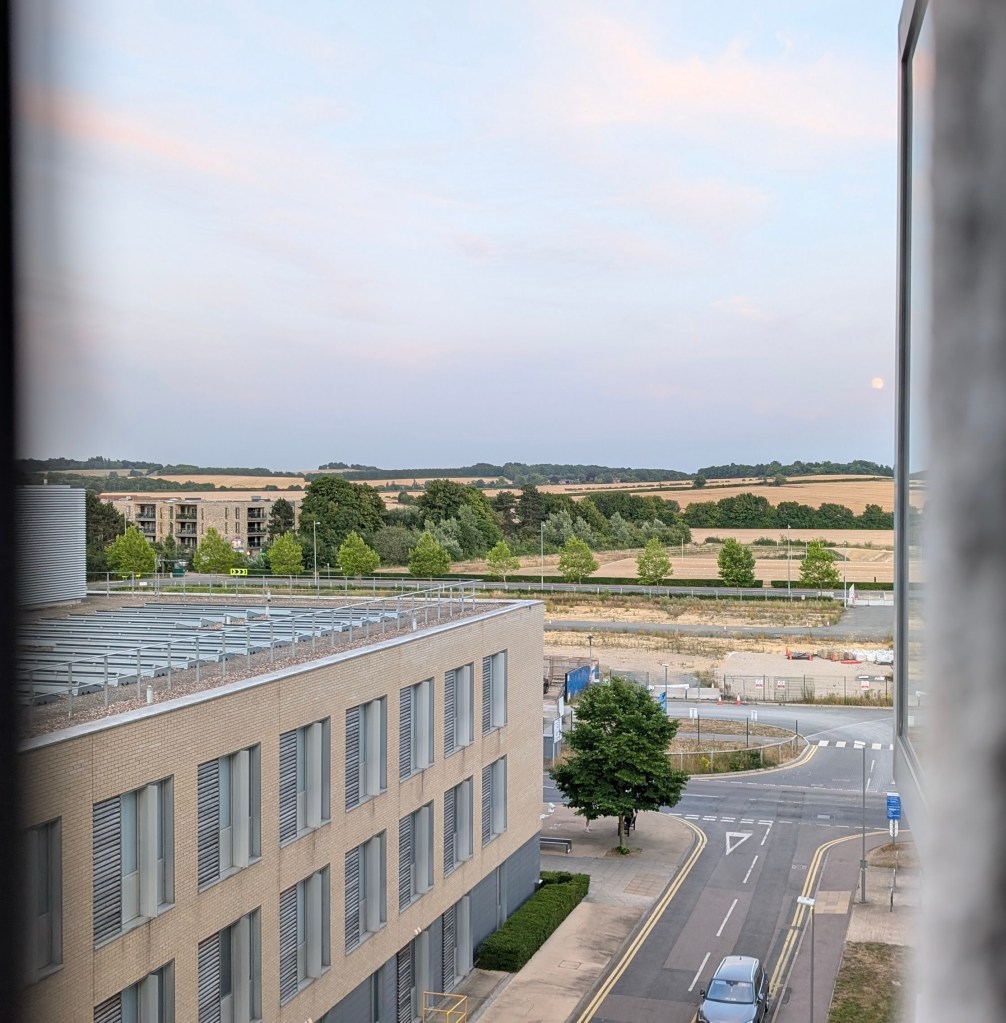
But my room? Easily the fanciest I’ve ever had in a hospital. Massive, with a view over Cambridge. It was a women’s room, pink gown and all, but I didn’t have the energy to care.
I watched the sunset. Fields. Hills. Quiet.
I didn’t sleep much that night either. Still sore. Still hard to swallow. But I drifted off now and then.
The Departure Lounge
Day three. I had breakfast. They said I could go home.
The departure lounge is a misleadingly glamorous name for a room where you wait for meds and paperwork. They had TV (“This Morning,” then “Loose Women”) and free snacks. And as much tea and biscuits as you could consume.
Challenge accepted.
Eventually, I got my meds and discharge note. A friend picked me up. The air outside felt warm and not like hospital. It was glorious.
Home and Healing
I got home, fell asleep at 2pm, and kept waking up every six hours for painkillers. Otherwise, I mostly slept.
Over the next few days, I was tired. My neck hurt. Swallowing got easier slowly. The bruises faded. I started going for short walks. I needed to move. To feel like myself again.
I found it hard to concentrate. I had fatigue that lasted a couple of months.
It took about four weeks to start feeling normal. The scar healed well. There’s some numbness around it, but it’s shrinking. Maybe it will stay. Maybe not.
With broken bones, you can see what’s wrong and track your healing. Strokes aren’t like that. You can’t always see the damage. Or know where you are in recovery.
Really the symptoms are gone now, so people wouldn’t notice I had a stroke.
But I did.
Fleeting Stroke
When I had the stroke, I wasn’t sure what to tell people. I told my neighbour I’d had a minor stroke, and saw them recoil at the word stroke. It’s a word that carries weight—too much, sometimes.
I looked online for stories about people who’ve had strokes. Most of what I found focused on the major ones—the life-altering, devastating kind. Which makes sense. Those are the stories that need to be told.
But the truth is: most strokes are minor. Some people don’t even know they’ve had one until it shows up on an MRI for something else. And the brain, remarkably, can recover. It can relearn lost skills. Heal itself.
These major-stroke narratives, though important, can skew how we understand strokes in general. It’s unfortunate, because when I first experienced symptoms, I didn’t think ‘stroke’—not even close. My assumptions got in the way. And many younger people who’ve had strokes say the same thing. They didn’t recognise the signs either, because the public picture of stroke is so narrow. I, like many others I’ve spoken to, assumed strokes only happen to the old or unhealthy—and that they always leave permanent damage.
When I was in hospital, I started thinking: maybe we need better language. “Minor stroke” and “major stroke” sound too similar. Maybe something like fleeting stroke—to describe those temporary-but-real events that resolve, or mostly resolve, with time.
The problem with the way we talk about strokes is that the word alone can eclipse everything else. People hear it and immediately redefine you.
So, about labels?
I don’t love stroke victim. Sounds like I was ambushed in a dark alley by cholesterol.
Not wild about stroke survivor either — feels like it gives the stroke too much credit. These were lazy strokes. Phoned it in. 3/10. Would not recommend.
If you insist, maybe: A stroke picked a fight with him — and got its arse kicked.
And here’s the thing: ever stubbed your toe?
Now imagine I label you as:
“Tragic victim of self-inflicted toe violence.”
Exactly.
I’m not a fan of labels.
Yes, I had a minor stroke. It’s part of me—but it doesn’t define me. I’m more than that.
I’ve broken bones. I’ve raced. I’ve written. I’ve designed.
I’m the sum of all those things, and more.
I’m still me. A little changed, but still whole.


 Davide la Locomotive
Leave a reply to Gareth John Owen Cancel reply