Preparation’s evil twin.
When I rode my first ever race, I looked like a cyclist preparing for the end of the world.
Not a 10-mile time trial.
I was about as aerodynamic as a brick, riding a completely standard road bike without a hint of aero help. I wore full winter kit because it was “a bit chilly” — and finished drenched in sweat. My pockets were bulging with food, tools, a spare jacket, and a water bottle (for a 27-minute effort). I even had a frame pump and saddle bag. Apparently, I thought I might need a snack or fix a puncture mid-race.
At the time, it all felt sensible. Responsible, even.
In retrospect, it was ridiculous..
At the next race, a more experienced rider from my club saw me like this and started pulling everything out of my pockets — multitool, food, spare jacket — muttering, “You don’t need this. Or this… Why do you have this?”
He did me a favour. I was never going to use any of it.
So next time, I took nothing. No drink, no food, nothing to mend a puncture. I didn’t need it. I’d just been dragging it all around for no reason.
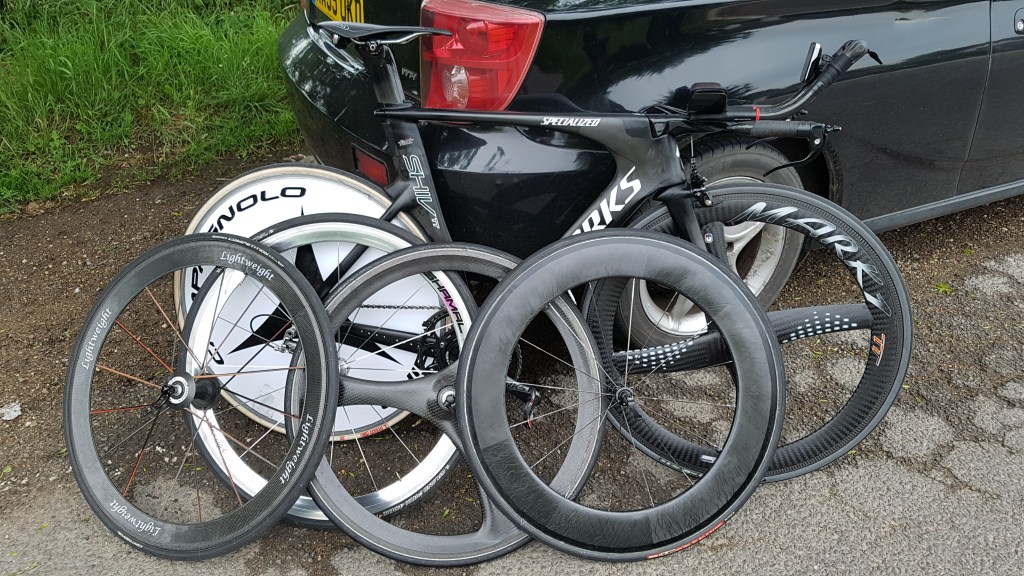
As I got better, I started racing almost every weekend. I’d solved what I carried on the bike… but not what I carried to the race. My car was ridiculous. I brought a full toolbox — just in case I needed to fit a new bottom bracket during warm-up. Spare cassettes, alternate wheels, tools for every conceivable mechanical disaster.
At one point, my car could have been turned into a mobile bike repair shop.
I could have completely dismantled my bike and cleaned every component in the car park of a race.
The thing is, that stuff never actually happened.
What did happen was I spent hours packing and unpacking gear I never used.
Slowly, I realised that time was coming from somewhere else.
Racing started to feel like a drag.
The excitement dulled.
The thing I loved was becoming work.
I thought about racing less.
Over the years, I’ve noticed something: the more time I spend preparing to do something — the more faffing, sorting, packing, just-in-casing — the less likely I am to actually do it. Faff has gravity.
I once knew a guy who had a fancy set of race wheels but never used them. Why? Because he didn’t want to wear out his drivetrain, which meant swapping cassettes each time — a tiny job that ballooned into a full workshop session.
The time cost grew. The friction grew. So he raced on his training wheels.
He had a point, but it still seemed ridiculous. Why have fast wheels if you never race on them? Especially when he worked in a bike shop and could get replacements easily.
I had a simpler solution: a race bike for racing and a training bike for training.
And that’s when I realised – what I’d been doing would have looked just as ridiculous to him.
When I started racing, I didn’t really know what I was doing.
I’d hear riders obsess over gear ratios and wheel choices,
so I assumed that was what fast people did.
I copied it. Because I didn’t know what actually mattered yet.
Later, I realised those guys were just faffing too — loudly.
In software, there’s an expression: YAGNI — “You Ain’t Gonna Need It.”
When building something, it’s tempting to add features you might need in the future, “just in case.” But those extras are almost never used. They still have to be tested, maintained, debugged — and often, when you finally go to use them, they don’t even work.
Hence YAGNI: only build what you need right now. Add the rest later, if you actually need it.
So I decided to apply the YAGNI principle ruthlessly to racing.
After years of racing, I knew the truth: the only tool I ever really needed was a multitool.
If something more complicated went wrong, I wouldn’t have time to fix it anyway.
Spare wheels? If I punctured during a race, that was game over — and my spares were always miles away in the car.
I used to take multiple front wheels for different wind conditions, but eventually I just practiced riding my fastest wheel in crosswinds. And then I rode that one. Every time.
A pump? No need — I pumped my tyres before I left.
Of course, there were still a few essentials: a towel, food and drink, a spare base layer or gloves if the weather changed.
So I bought a rucksack and made a rule: everything I needed had to fit in there.
If it didn’t fit, I had to get rid of something.
If I wanted to add something new, something I wasn’t using had to go.
Once I’d sorted that, I stopped spending hours shuttling things between the house and the car. I just made one trip: me, my bike, my bag.
That’s it.
It was never really about the pump or the tools.
It was about the overhead of racing.
I’ve seen the same pattern elsewhere.
The more steps it takes to get on the turbo, the less often I do.
Strip it back, and suddenly consistency appears.
That’s the faff paradox.
The more unnecessary preparation I added,
the less prepared I actually was.
Later I might have looked less prepared because I didn’t bring a pump.
But I was so prepared, I knew I didn’t need one.
Once I spotted it in cycling, I started seeing it everywhere.
What mattered wasn’t whether I could do the thing.
It was whether I could keep doing it.
Over time, I learned to recognise the difference:
preparation that lowers the overhead,
and faff that quietly raises it.
Faff isn’t preparation.
It’s friction.
 Davide la Locomotive
Leave a comment