From Desk Burnout to Cybernetic Couch Potato
A friend and I used to joke about what it meant to be “really trying”.
At first it was fairly tame.
You know — if you’re not doing X, you’re not really trying.
Over time, X got worse.
If you don’t have blurred vision, you’re not really trying.
If it doesn’t feel like you’ve actually broken a bone in your foot, you’re not really trying.
And then one day, I saw what the joke was pointing at.
I was at the national para track championships, watching the pair that had just won.
During the warm-down, she was on a turbo trainer —
riding while vomiting into a bucket.
I remember thinking, “jeez, I’ve never ridden that hard.”
I wasn’t training for the Olympics, but I was doing the exact same thing to my spine.
Desk Burnout
When I started writing, I sat at a desk and typed.
Like I think most people do.
But after a full day working at a desk, spending my evenings in the same place felt like I never really left work.
I tried other ways to write.
I swyped on my phone — great when out and about.
I wrote on a plane, while walking, even in the bath.
But it’s slow and didn’t just get characters wrong, it turned whole sentences into gibberish I’d later have to decipher.
I tried text-to-speech, but I don’t speak like I write.
If I did, my posts would be full of “Um’s” and “Ah’s”.
So I went back to the desk.
It was the most effective way to write.
As I wrote more, I spent more time there.
Less time actually relaxing.
It started to feel like a choice:
write and be uncomfortable,
or relax and let the ideas slip away.
I wanted both.
So I started thinking of ways to improve my writing setup.
Recline Refinement
I have a nice reclining chair, and I thought that might be a more comfortable way to write.
The chair itself was lovely—genuinely relaxing. But the laptop was the problem. The screen was too far away and the keyboard too cramped. My wrists started complaining. I’d squint or blow up the font so huge I could only see a few words at a time.
It should have been comfortable. Instead, it was awkward and painful—like the chair was winning but the laptop was losing.
So I bought an arm mount for the laptop and a Bluetooth keyboard, thinking I could separate them, give myself space.
I’ve never been a fast typist.
But after a few weeks of practising touch typing, I got much better —
I can type in the dark now, if I want.
It helped. Reclining while writing was better. My body was more relaxed. I could write for longer.
But it still didn’t feel right. It was still writing in “work mode.”
Honestly, reclining while writing is great —
but it’s not lounging on the sofa, is it?
I felt like I could do better than this.
The Gooseneck Refinement
Years ago, I don’t remember why but I bought a strange contraption—a human-mounted phone holder. Unlike most phone holders that attach to a desk or table, this one attaches to you.
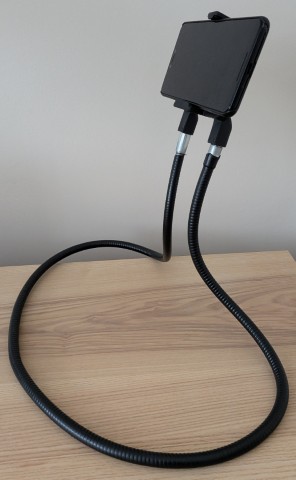
You wrap an articulated gooseneck arm around your body, and the phone sits in front of your face.
It does not make a good fashion statement.
It looks absolutely ridiculous.
But it’s effective.
One evening, I was lying back on the sofa, watching a video on the tiny screen. It was so comfortable. Just… lounging. No desk, no chair, no strain.
The problem with laptops is backwards. You want the keyboard far away so your arms are relaxed, but the screen close so you can actually see it. Laptops glue them together. Terrible design.
This plus a Bluetooth keyboard would give me both. And I could touch type now—so I wouldn’t need to see the keyboard.
For the first time, writing didn’t feel like something I had to arrange my body around.
There was just one problem.
The screen was tiny.
Adaptor-ception
I found a wider clamp and bought a 12-inch tablet. My hope was to clamp the tablet mount onto the phone mount—mount holding mount holding tablet.
It didn’t work.
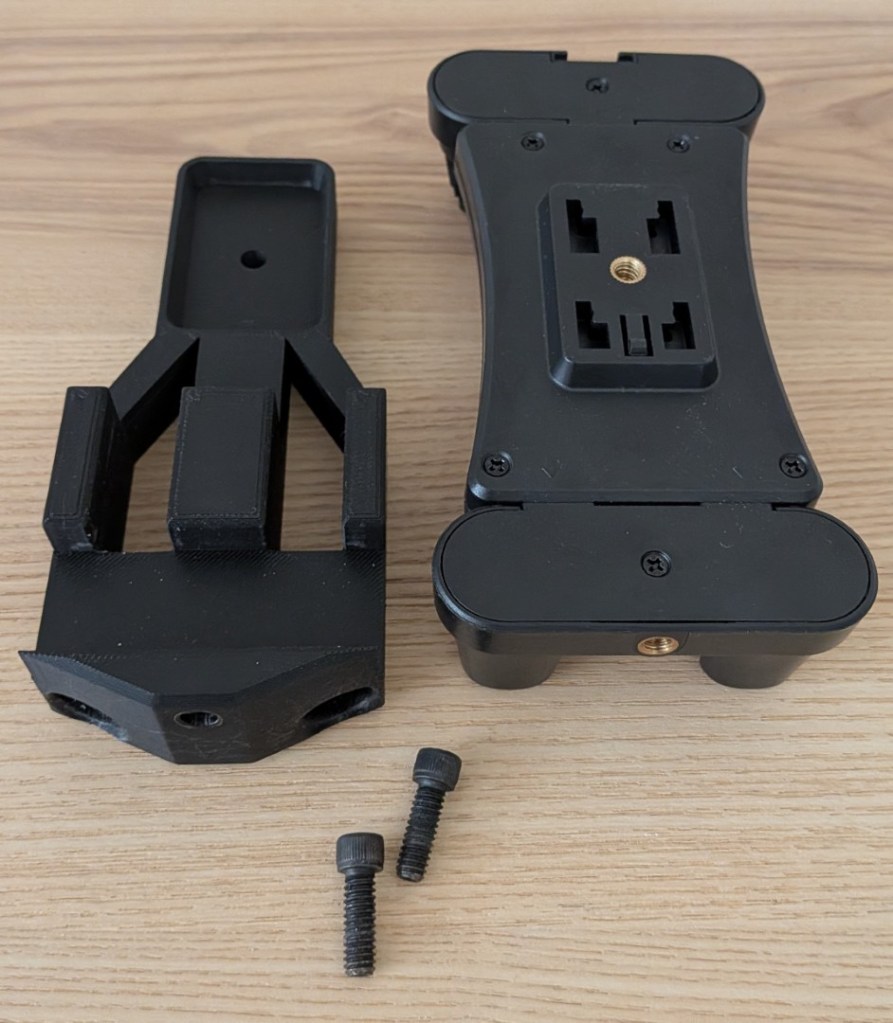
So I spent a few hours designing and making an adaptor plate to solve a problem I had definitely created myself.
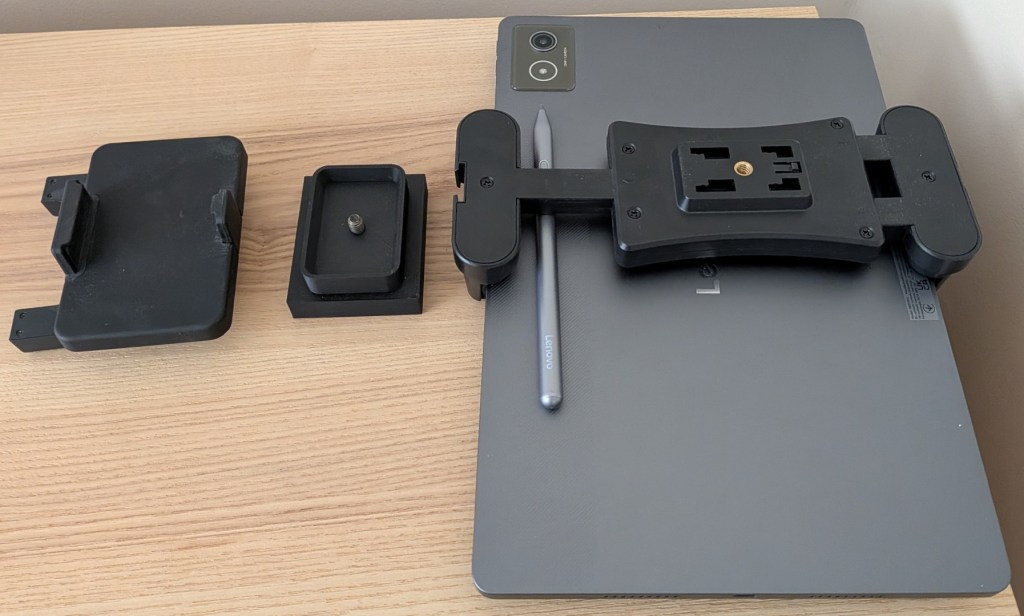
The result was the cludgiest thing I’ve ever made: a clamp, clamping a dodgy adaptor, connected to another mount. Like an octopus hugging a tablet.
It looked absolutely awful.
I connected it all together and…
WOOOOOW.
It just worked.
I loved it immediately.
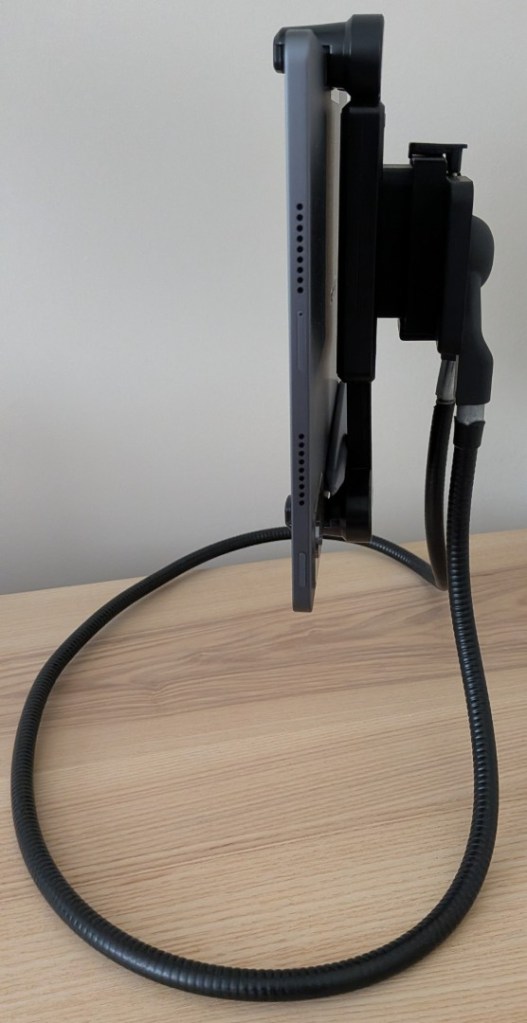
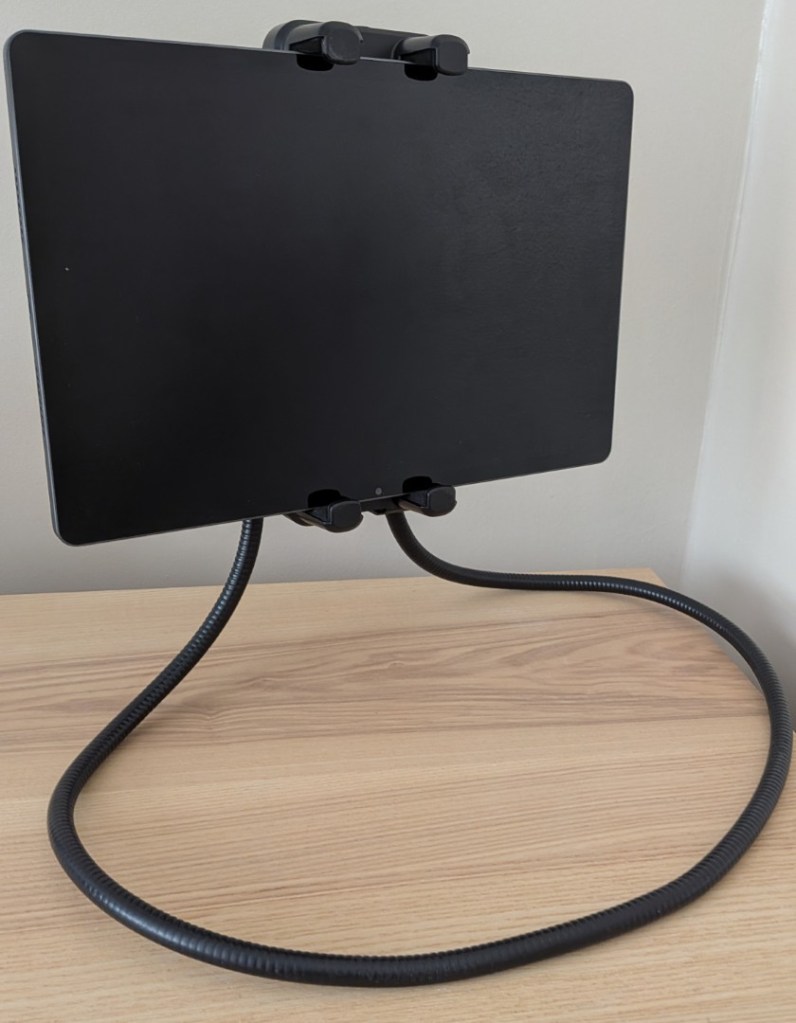
Usually, when you build a contraption like this, it’s a disaster. You stand there wondering what madness possessed you. But this was the glorious opposite: a pure, instantaneous ‘how did I ever live without this?’ epiphany.
I was too busy actually using the thing to bother redesigning it into something prettier. The janky octopus was doing its job.
Later I modified the adaptor to connect directly to the gooseneck arm.
That worked even better.
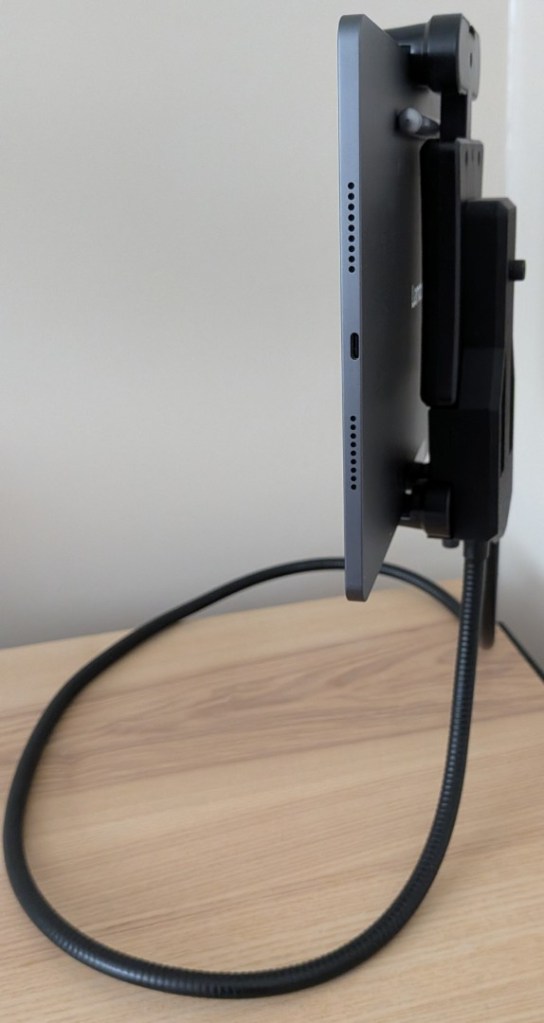
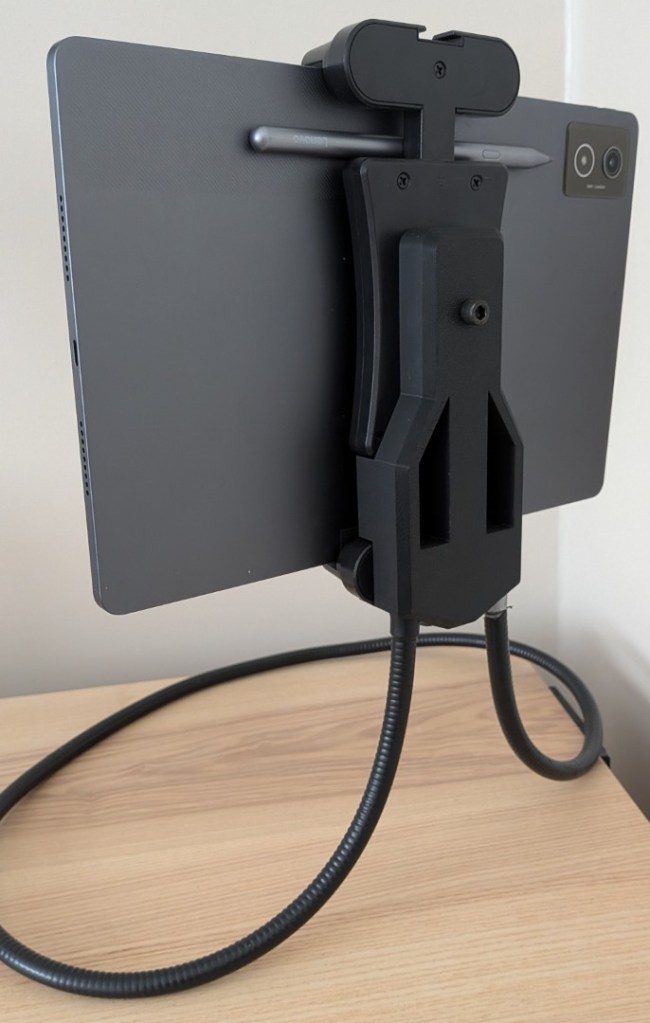
Most tablet arms attach to a desk.
Mine attaches to me.
Which I suppose makes me the desk now.
I’ve become the furniture I once resented.
The LayTop
Even though the gooseneck mount is just hardware, it completely changed how writing feels.
I’ve been using this setup for a few months now, and I don’t want to go back.
Writing no longer feels like something I have to endure.
Reclining in a chair and typing feels nicer than sitting at a desk.
It’s more relaxed, and I can write for longer without feeling worn down.
Lying on the sofa is even better.
I can put my feet up, with the keyboard on my lap, whilst my lava lamp gently glows and I listen to relaxing music.
It’s such a long way from sitting at a desk that it almost feels like cheating.
Now, writing really doesn’t feel like work.
It feels like being tucked up in bed reading a bedtime story, one I get to write.
Which is slightly undermined by the fact that, from the outside,
I look like I’m chatting with the robot from Flight of the Navigator.
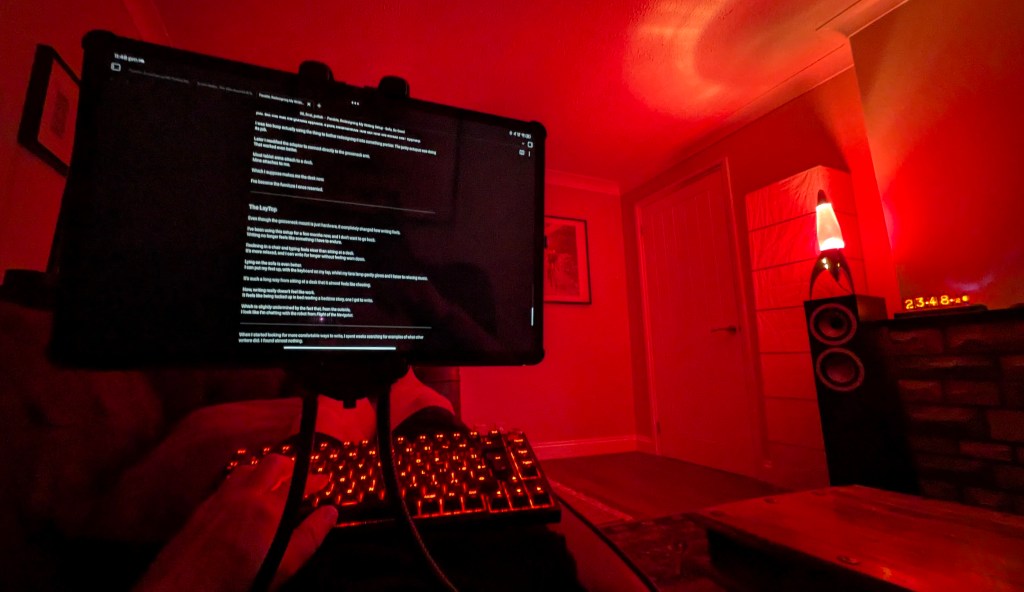
When I started looking for more comfortable ways to write, I spent weeks searching for examples of what other writers did. I found almost nothing.
I had sat at a desk simply because that’s what writers do. It’s what we see on TV. I didn’t question it—it just seemed like the default setting for serious work.
But looking back, I realize I was buying into a much larger, quieter myth: the idea that creativity needs to hurt.
We romanticize the tormented writer, hunched over in isolation, suffering for their art. We tell ourselves the same cultural tropes:
Heartbreak makes great music.
Tortured artists are the only authentic ones.
No pain, no gain.
There is a strange, deceptive comfort in thinking that if you’re uncomfortable, it must mean you’re doing it right.
That discomfort equals discipline.
But that myth is dangerous. It makes people give up too soon, or never start at all.
Building this ridiculous, janky setup taught me that creativity shouldn’t be a test of physical endurance. The best stories don’t come from suffering; they come when you finally stop fighting your environment and just let yourself create.
As it turns out, the muse doesn’t care if you’re sitting at a pristine mahogany desk or looking like a sci-fi cyborg on the sofa. She just wants you to write.


Leave a Reply