
Strapping tiny, vibrating engines to my head for fun and safety.
I’m no Luddite. But every now and then, a piece of technology arrives that doesn’t just upgrade your routine—it completely recalibrates how you experience the world. Once you cross that line, there is no going back.
For years, I never listened to music while cycling. The open road is a beautiful place, but let’s be honest: after a few hours, it can get a bit boring. Regular earphones were out of the question. Sealing yourself into a plastic audio bubble while navigating traffic is less “recreation” and more “testing your life insurance policy.”
Then I discovered bone-conducting headphones.
They sit just in front of your ears, sending vibrations directly through your skull. Your ears remain completely unplugged, fully aware of the ambient world, while the audio bypasses them entirely. The sensation is uncanny. You don’t feel like you are hearing the music through a speaker; it feels like you are thinking the music.
Suddenly, I had the ultimate cycling compromise. I could ride through the mountains accompanied by my favorite Spotify playlists, while remaining perfectly capable of hearing approaching cars—or the occasional charming motorist screaming at me to “Pay road tax!”
It was a revelation. But as it turned out, introducing consumer electronics to the brutal, elements-blasted reality of daily cycling is a dangerous game. What followed was a decade-long saga of audio companionship and tragic, structural ruin.
The Ancestral Heavyweight: The Bluez (2012)
My first foray was a pair of Aftershokz Bluez back in 2012. They were bulky, heavy lumps of plastic that clamped onto my head with the subtle grace of a vice grip. They weren’t comfortable, but they worked and the battery lasted forever.
They were rated only for basic water resistance, surviving years of unexpected downpours. Their undoing, however, was far more intimate. One afternoon, needing a soundtrack for a punishing indoor turbo-trainer session, I grabbed them. A single hour of me profusely sweating like a malfunctioning radiator completely dissolved their internal machinery. The main button ceased to button; the sound warped.
To their credit, Aftershokz replaced them. But after a couple of years of daily riding, those replacements also succumbed to the grind.
The Mid-Era: The Titaniums & The Airs
Next came the Titaniums. These were lighter, more flexible, and felt like the future. They served valiantly for several years until a fateful trip to the Pyrenees. In a moment of casual mid-ride relaxation, I slipped them off and let them rest around my neck. A sudden, sharp twist of my head exerted some accidental, superhuman leverage, and I literally ripped one of the structural arms wide open. Death by posture.
I replaced them with the Aftershokz Air. Even lighter, even more comfortable. They lasted two years until I packed them into my luggage with reckless optimism. They were promptly crushed into modern art by the weight of my own baggage.
By this point, I had noticed a definitive law of technological evolution: the lighter and more elegant the headphones became, the more fragile their disposition.
The Dark Age of High-End Tech: The Aeropex
Enter the Aeropex. These were the pinnacle of the line—feather-light, completely sealed against the elements, and sporting a fancy, bespoke magnetic charging cable. They should have been invincible. Instead, I entered a dark, comedic loop of rapid-fire hardware failures.
I went through a biblical run of bad luck where a pair would only survive a few months at a time:
- Pair 1: The specialized charging port corroded into a useless green crust.
- Pair 2: One earphone simply stopped vibrating, leaving me in mono.
- Pair 3: A mysterious loose connection caused the audio to cut out whenever I looked left.
- Pair 4: The internal software crashed mid-pairing and the unit effectively went into a permanent vegetative state.
The Triumphant Underdog: The OpenMove
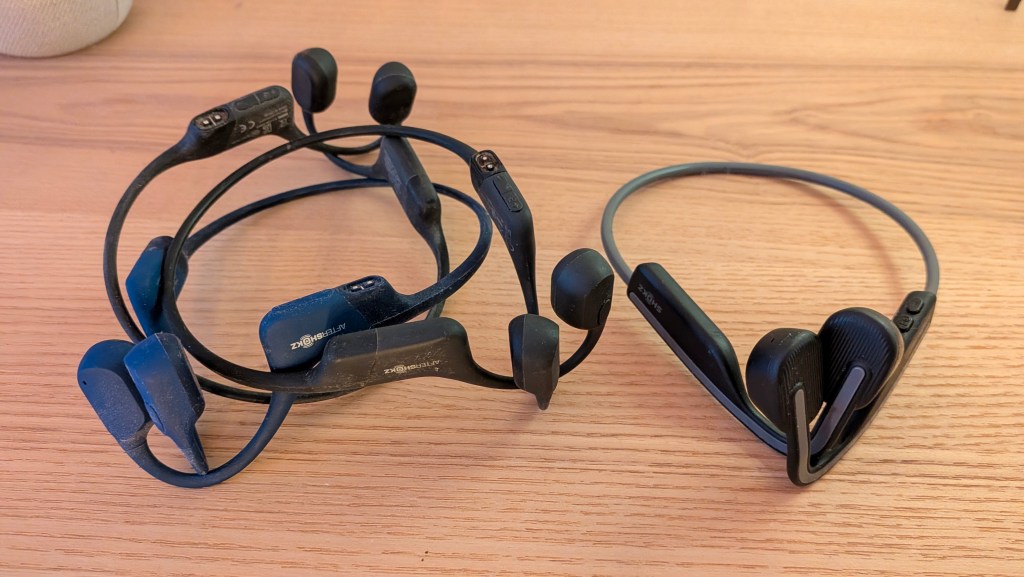
Exhausted by the drama of high-end engineering, I finally threw in the towel and bought the Shokz OpenMove. They are the budget option. They are a bit clunky, a bit thick, and lack the sleek, featherweight pedigree of their expensive siblings.
I have had them for two and a half years now. They refuse to die.
The Reality Check: What Are They Actually Like?
Let’s be completely honest about the user experience: if you are looking for deep, skull-rattling sub-bass that makes you feel like you’re standing in the middle of a nightclub, look elsewhere. Bone conduction just can’t do that. The sound is undeniably a bit tinny, and the audio quality is average at best.
They also bleed noise like a leaky pipe. If you wear them in a perfectly quiet room, anyone sitting next to you will be treated to a faint, tinny rendition of whatever you’re listening to. They are absolutely not designed for libraries or commutes.
But out on the road? None of that matters.
Once they are on, they completely disappear. They aren’t heavy, they don’t pinch, and you genuinely forget you are wearing them. And the utilitarian payoffs are massive:
- The Battery: I can go out for a grueling 12-hour ride, and they are still going strong when I roll back into the driveway.
- The Weatherproof Instinct: I have ridden them through absolute torrential rain—the kind of biblical downpour that makes you question your life choices—and they didn’t skip a single beat.
They are, fundamentally, sports gear. They are built for times when you need to be completely aware of your surroundings while running or cycling, without the world turning into a silent movie.
The True Metric: The Sound of Solitude
But technical specifications and battery life only matter up to a point. The real reason I keep strapping these things to my head isn’t about the hardware at all. It’s about how it feels when the music and the movement completely melt together, becoming inextricably linked forever.
When you spend that many hours on a bike, a soundtrack stops being background noise and becomes part of the geography. To this day, I cannot listen to Arcade Fire’s Reflektor without immediately feeling the phantom, endless ache of the long slog from Land’s End to John O’Groats.
And then there are the moments that border on the sacred.
I remember a grueling day in the Alps. I had just finished climbing the Col d’Izoard—a busy, frustratingly crowded stretch of road that left me feeling completely uninspired. But then I turned onto the Col d’Agnel, winding its way up to the Italian border.

Suddenly, the crowds vanished. The road fell completely silent, and the landscape transformed into something primeval. There were no forests here. Just vast, sweeping grassy pastures and colossal, towering rock formations that looked as though they hadn’t changed for hundreds of thousands of years. The only evidence of human existence was the impossibly thin strip of tarmac that wound its way slowly up into the sky.
I spent hours climbing that mountain. The air was getting thin, the heat was heavy, and I was so thoroughly, utterly exhausted that I was borderline hallucinating. The entire time, my headphones were channeling Boards of Canada—trippy, melodic, wordless electronic landscapes.
Because of how the headphones work, the music wasn’t fighting the silence of the mountain; it was existing inside it. In that state of absolute exhaustion, the music felt less like a recording and more like the natural ambient noise of my own brain.
Looking out at those ancient, empty rocks, I had this distinct, uncanny sensation that I had accidentally cycled right off the face of the earth and onto another planet entirely. A planet where there were no people, no emails, no deadlines—just the rhythm of my legs, the timeless stone, and a melody vibrating through my head.

This is why I put up with the tinny sound and the occasional catastrophic hardware failure. They aren’t just for listening to music while cycling; they add a soundtrack to every ride.


Leave a Reply